
Top Signs You Need Garage Door Service – Don’t Ignore These
A garage door that takes three seconds longer to open than it did six months ago isn’t running slow. It’s telling you the springs are losing tension, and springs that fail completely don’t drift. They snap. Most of what we repair at Brock Garage Door Repair in Los Angeles started as a small, ignorable symptom twelve months before it became a door stuck halfway up the track on a Monday morning. If you’d rather skip the guessing and have a trained technician look at it, call (254) 602-5116 for a free estimate.
Key Takeaways
- A slower-than-normal door almost always means torsion springs are near the end of their rated cycle life.
- A door that’s lower on one side points to a cable or drum problem, not a spring problem, and it gets expensive fast if ignored.
- Different noises diagnose different components: grinding is rollers, squealing is hinges or bearings, popping is springs.
- A door that reverses before it fully closes is a safety sensor issue, and bypassing it puts kids and pets at risk.
- A five-minute visual inspection can tell you whether you need service this month or can wait until fall.
The Slow Door: What “A Little Sluggish” Actually Means
Every torsion spring, the thick coiled spring mounted above the door that bears most of the lifting load, is rated for a specific number of cycles. One cycle is one full open and close. Most springs installed in Los Angeles homes are rated for 10,000 cycles, which works out to roughly seven to ten years of normal use, depending on how often you use the door as a front entrance. When a spring loses tension, the opener motor has to work harder to move the same weight. That extra three or four seconds you notice? That’s the spring passing its useful life, not the motor getting tired.
Here’s the math that matters. A door that still opens but takes noticeably longer is typically two to six months from a complete spring failure. That failure usually happens mid-cycle, which means the door freezes wherever it is. If that’s halfway up and you have a car in the driveway, you’re not getting the car out until the spring is replaced. We’ve pulled springs out of garages in neighborhoods across Los Angeles where the homeowner said, “It’d been slow for a while, I just figured it was cold weather.” Cold doesn’t slow your door down meaningfully. Worn springs do.
If your door is moving slower than it did last year, or slower than the neighbor’s identical door, schedule service before it fails completely. A spring replacement is predictable, same-day work in most cases. A spring failure is predictable only in that it happens at the worst possible moment.
A Door That’s Crooked: The Cable and Drum Warning
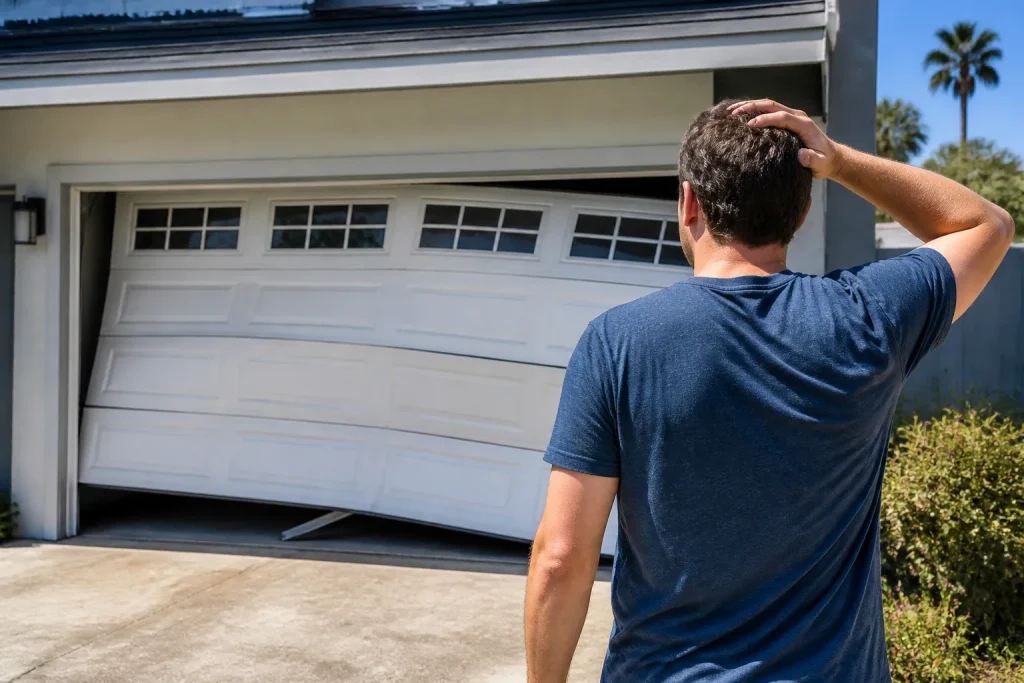
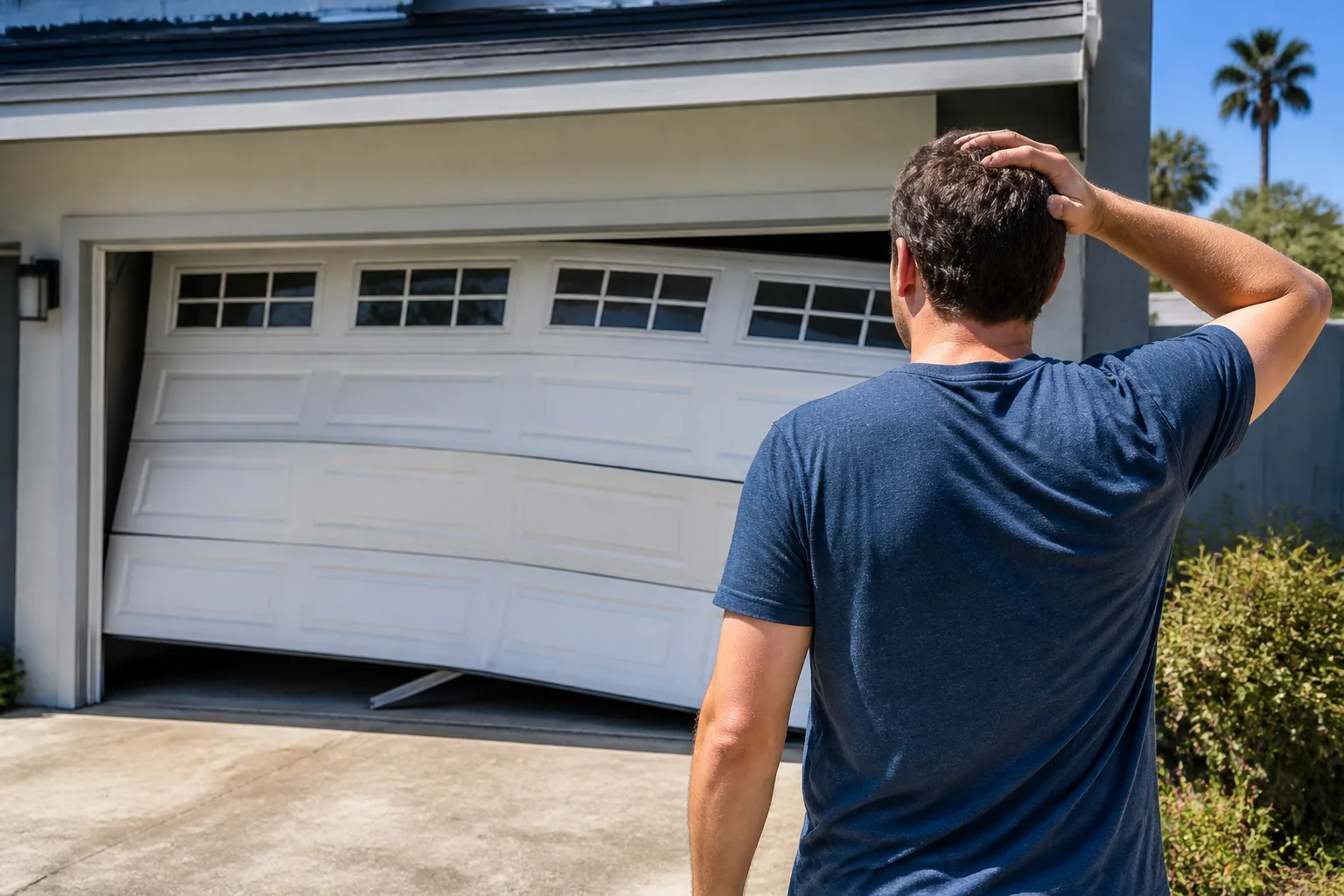
Look at your garage door from the street. Is the bottom edge level? If one side hangs an inch lower than the other, that’s not a cosmetic issue. That’s a cable that’s lost tension or a drum, the grooved wheel at each end of the torsion bar that the cable winds onto, that’s slipping. The cables on either side of the door are supposed to work in perfect sync. When one side goes slack or the drum loses its grip, the door starts lifting unevenly.
Uneven lifting puts twisting force on the entire door assembly. The rollers grind sideways in their tracks. The hinges bend. Eventually a roller pops out of the track, and now you have a door that’s off-track and potentially leaning against whatever is under it. We see this regularly in Los Angeles garages where the door gets used four or five times a day. What would have been a $150 – $275 cable repair becomes a full track realignment, a new set of rollers, and half a day of labor if the door has been running crooked for weeks.
The moment you notice one side lower than the other, stop using the door and call for service. This is not a “keep an eye on it” situation. Cable and drum problems go from minor to emergency without a dramatic announcement.
What Your Door Is Telling You When It Makes Noise
Noise is the most useful diagnostic a garage door gives you, and most homeowners tune it out after the first month. Here’s what each sound actually points to:
- Grinding or rumbling while the door moves: worn rollers. The metal wheels that ride inside the track either have flat spots or their ball bearings have failed. Roller replacement is one of the least expensive repairs we do, typically under $200 for a full set, and it quiets the door immediately. Ignoring rollers means the track itself starts wearing, and that’s a much bigger bill.
- Squealing or high-pitched shrieking: dry or failing bearings in the hinges or the end bearing plates above the door. Some noise is normal for a door that hasn’t been lubricated in years. Noise that persists after lubrication, or that’s high enough to hear inside the house, means a bearing is going. Bearings are cheap. The door sections they support are not.
- Popping or snapping during operation: a spring that’s starting to bind or is in the early stages of failure. This is the one sound you should treat as a five-alarm warning. Springs under tension that bind are springs that fail suddenly. If you hear this, don’t operate the door manually to see what’s wrong. Call a technician.
Torsion springs are under hundreds of pounds of tension at all times, even when the door is closed. We never advise homeowners to touch them. In our experience across Los Angeles, the grinding noise that got ignored for six months is the single most common reason a $40 roller replacement turns into a $400 track repair.
When the Door Reverses Mid-Close: A Safety System, Not a Nuisance
Since 1993, every garage door opener in the United States has been required to include a safety reversing mechanism. There are two types: photoelectric sensors mounted low on either side of the opening that project an invisible beam, and a force-sensing system that reverses the door if it hits something on the way down. When your door starts closing, stops, and goes back up for no apparent reason, one of these systems is operating exactly as designed, or one of them is malfunctioning.
The most common benign cause is a misaligned sensor. A soccer ball rolls into the sensor, it gets bumped by a bike, and now the beam doesn’t connect, so the opener behaves as if something is in the way. That’s a five-minute fix and it’s protecting you correctly. The less benign cause is a limit-switch fault inside the opener motor itself. The limit switch tells the opener when the door has fully closed. If the switch is failing, the opener thinks the door hit something and reverses.
We want to be direct about this: bypassing a reversing sensor, or holding the wall button down to force the door closed, disables a federally mandated safety system. If you have children or pets, a door without a working reversing system is a crushing hazard. A properly working garage door will stop and reverse when it contacts a 2×4 laid flat on the ground. Test yours with a roll of paper towels once a month. If it crushes the roll, the force setting is too high and the door needs service. This is the one check we tell every Los Angeles homeowner to do, because it takes ten seconds and it can save a life.
The Five-Minute Visual Inspection Any Homeowner Can Do
You don’t need tools to know whether your garage door needs professional attention. Stand in your garage with the door closed and work through this list:
1. Springs. Look above the door. You’ll see either one or two torsion springs. Do they look straight and uniform, or do you see gaps in the coil, rust, or a spring that’s in two pieces? A broken torsion spring is obvious: there’s a gap in the coil. If you see one, don’t try to open the door manually. The opener may not be able to lift the full weight, and the door can come down hard.
2. Cables. The cables run down both sides of the door from the drums at the top. They should be taut, not frayed, not rusty, and wound neatly on the drums. A cable that’s unwound or has loose strands is a failure waiting to happen.
3. Rollers. Look at the wheels that ride in the track. If the wheel itself has chunks missing from the nylon coating, or the metal stem looks bent, they’re done. Rollers don’t recover.
4. Weatherstripping. The rubber strip along the bottom of the door and the vinyl trim around the opening should be intact, not cracked or sagging. In Los Angeles, failed weatherstripping means dust, insects, and hot air in the garage, and if the bottom seal is gone, the door is sitting directly on concrete, which accelerates panel wear.
5. Tracks. The vertical tracks on either side should be plumb and free of obvious dents or gaps where they bolt to the wall. A track that’s been hit by a car or a garbage can bends the geometry of the whole system, and the door will work harder and wear faster until it’s corrected.
If everything on this list passes, your door is in reasonable shape and you can stay on an annual schedule. If you find one thing that fails, call a professional before it takes something else down with it. Brands like Genie, Clopay, Amarr, and Wayne Dalton all use similar component standards, so the inspection works across most doors in Los Angeles, but the specific fix depends on the system you have, which is why we train our technicians on all of them rather than guessing.
When to Call a Pro
Some things you can handle yourself: reconnecting a loose sensor, lubricating hinges with white lithium grease, replacing the weatherstrip on the bottom of the door. Some things you should not touch at all: springs, cables, and anything that requires winding or unwinding the torsion bar. The stored energy in a garage door spring is enough to send a metal part through drywall. We’re not being dramatic. That’s the physics.
If you’ve found any of the warning signs in this post, a trained technician can diagnose the problem in under an hour and give you a number on paper before any work begins. That’s how we run every job at Brock Garage Door Repair. Written price first, work second, invoice matching the quote. No surprises at the door. And if the repair fails within a year, we come back and fix it at no charge, in writing, under our 365-Day Done Right Promise. A live person answers our phones 24 hours a day, including holidays, so you’re not leaving a voicemail into the void when your door fails on a Sunday.
Related services in Los Angeles: Garage Door Repair in Los Angeles, Garage Door Opener Repair in Los Angeles, and Garage Door Cable Repair in Los Angeles. We also work on openers and doors from Genie, Clopay, and Wayne Dalton systems throughout the area.
The Bottom Line
Garage doors don’t fail without warning. They slow down, they go crooked, they grind, they reverse when they shouldn’t, and they show you visible wear on springs, cables, and rollers. Each of those symptoms has a specific mechanical cause and a predictable timeline to failure. The question isn’t whether to address them. It’s whether you address them on your schedule or the door’s schedule. And the door doesn’t call ahead.
If you’re in Los Angeles and something on this list matches what you’re seeing, Brock Garage Door Repair home is one call away. We’ll give you a free estimate, a written price before any work starts, and a repair backed in writing for a full year. Call (254) 602-5116.
Frequently Asked Questions
Most common repairs in Los Angeles run between $150 and $450 depending on the component. A roller replacement is typically under $200. A cable repair runs $150 – $275. A torsion spring replacement usually falls between $250 and $400 for a single spring, more for a two-spring system on heavier doors. The exact number depends on your door’s weight, size, and spring type, which is why we hand you a written quote before any work starts. Call (254) 602-5116 for an exact figure. Estimates are free.
In most cases, yes. A live person answers our phones 24/7, and common repairs like spring replacement, cable repair, and roller replacement are same-day jobs for our technicians. We carry the most common parts for LiftMaster, Chamberlain, Genie, Clopay, Amarr, Wayne Dalton, Craftsman, and Raynor systems on the truck. Call (254) 602-5116 and we’ll give you a real arrival window, not a four-hour guess.
No. The price you’re quoted in writing before work begins is the price you pay when the job is done. If the technician finds something additional during the repair, we show you what we found, explain it in plain English, and get your approval on a new written quote before touching it. You never owe more than the number you approved.
A standard torsion spring is rated for 10,000 cycles, which averages seven to ten years for most Los Angeles homes. If you use your garage door as your primary entrance and it opens and closes six to eight times a day, that number drops to four to six years. High-cycle springs rated for 25,000 or 50,000 cycles are available and worth considering if you plan to stay in the home. If your door is slowing down and the springs are five or more years old, they’re telling you the end is near.
Written by Wade Mercer, Owner at Brock Garage Door Repair, serving Los Angeles since 2001.
Need Garage Door Help?
Call Brock Garage Door Repair - licensed & insured, here with fast after-hours help in Los Angeles.
(254) 602-5116