
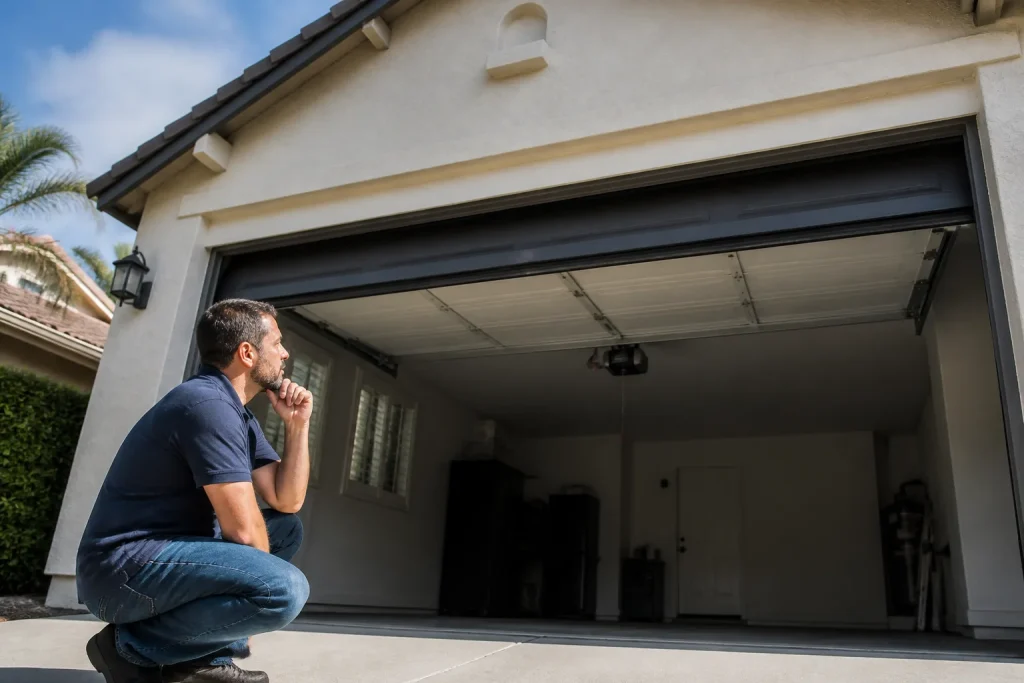
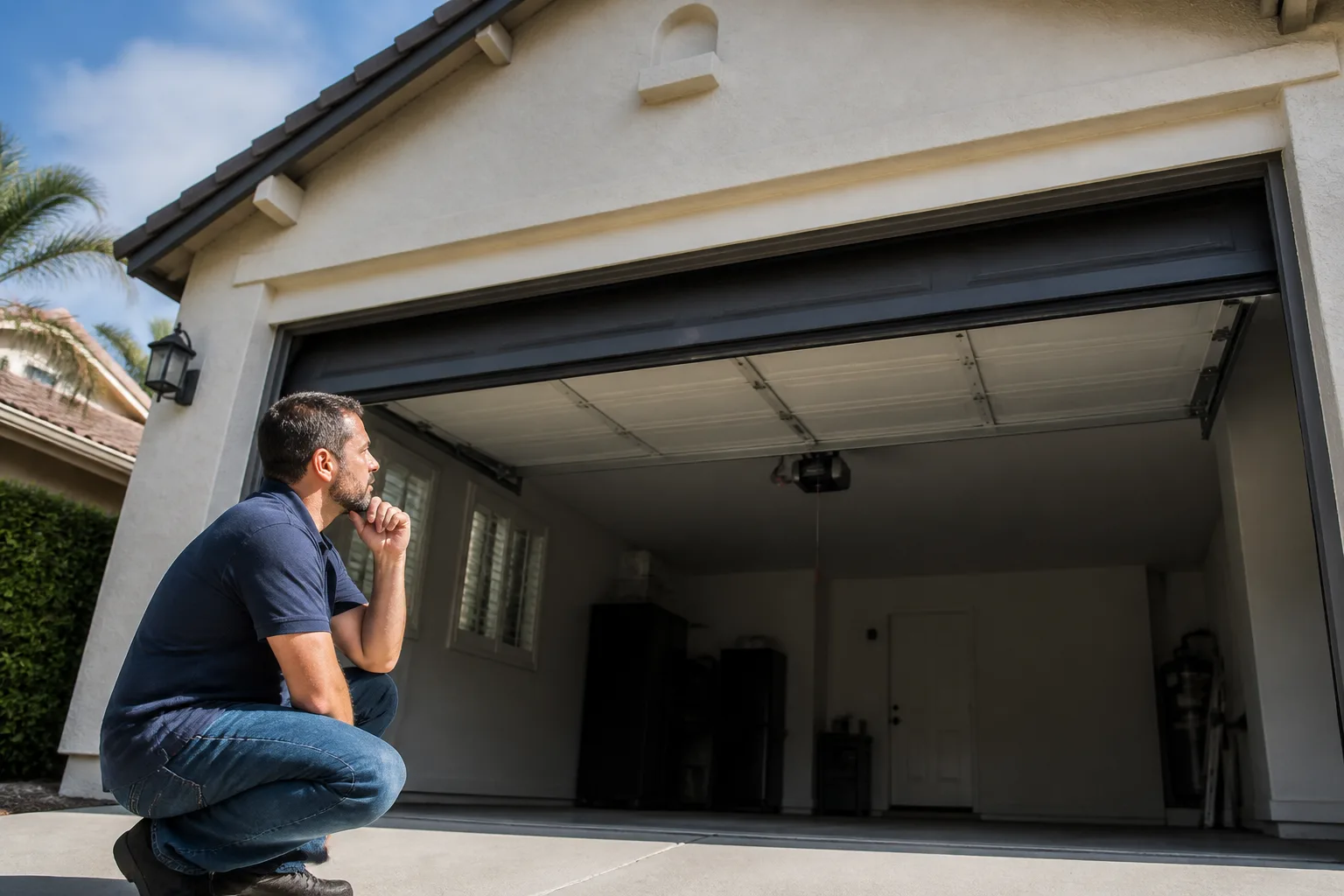
Garage Door Opener Repair: Repair or Replace? How Los Angeles Homeowners Decide
Here’s the short answer: a garage door opener that’s 11 years old and needs a new sprocket is worth fixing. The same opener with a failed logic board probably isn’t. The difference comes down to which component failed, not the opener’s birthday. If you’d rather not diagnose it yourself, call (254) 602-5116 for a free estimate from a technician who can tell the difference in the first five minutes.
Most Los Angeles homeowners approach this decision backward. They look at the age of the unit and assume 10 years means replace, 5 years means repair. Age matters, but it’s a secondary variable. A 12-year-old Chamberlain with a worn sprocket might run another five years for $160 in parts and labor. A 7-year-old Genie with a fried logic board is often cheaper to replace than to fix. The component that failed is what actually determines value.
The Component Framework: Drive System vs. Control System Failures
Every garage door opener has two distinct systems, and the repair-or-replace math differs wildly between them. The drive system is the mechanical part: the chain or belt, the sprocket, the carriage, the motor itself. The control system is the electronic part: the logic board (the circuit board that runs everything), the safety sensors, the wiring harness, the wall console.
Drive system failures are usually mechanical wear. A sprocket strips out, a belt frays, a carriage cracks. These parts are inexpensive relative to the cost of a new opener, and replacing them genuinely extends the unit’s life. In Los Angeles, where garages often see daily use because street parking is a lottery, a drive system repair on a healthy motor is almost always money well spent. Most drive system repairs in Los Angeles run $120 to $275, including parts and labor.
Control system failures are a different animal. The logic board is the opener’s brain. When it fails, the replacement board alone often costs $150 to $250, and labor pushes the total toward $300 or more. A brand-new mid-range opener from LiftMaster or Chamberlain runs $250 to $400 installed. That’s the moment where “repair” stops making economic sense. You’re paying new-opener money to keep an old-opener motor alive.
We’ve pulled logic boards out of units over in the Valley where the replacement part cost more than four years of remaining motor life. Homeowners who got a straight answer saved themselves sixty dollars and six months of watching a dying opener limp along.
Symptoms That Tell You Which System Failed
- Door hums but doesn’t move: Usually a drive system problem like a stripped sprocket or broken gear. The motor works; the mechanical link doesn’t.
- Opener is completely dead, no light, no response: Control system. Could be a board, a wiring fault, or a failed transformer.
- Door reverses immediately after touching the floor: Safety sensor or force-limit logic. Often a $100 to $150 fix, sometimes just a sensor realignment.
- Intermittent operation, works sometimes then stops: Almost always the logic board. These failures start ghost-intermittent and progress.
- Remote and wall switch both fail: Board or receiver module. Not the remote battery.
How to Read Your Opener’s Model Number to Know if Parts Still Exist
Before you and a technician go back and forth about whether a repair is possible, look at the model number printed on the opener housing. LiftMaster, Chamberlain, and Genie all stamp models on the side or rear of the motor unit. The label also carries the manufacturing date, sometimes as a four-digit code showing year and week.
Here’s why this matters for Los Angeles homeowners specifically: many homes in neighborhoods like Sherman Oaks, Eagle Rock, or Westchester had openers installed during remodels or garage conversions in the 1990s and early 2000s. Some of those units are discontinued. Not “old” – discontinued. The manufacturer stopped producing replacement parts entirely.
If a drive component fails on a discontinued unit, sometimes a generic part fits. If the logic board fails on a discontinued unit, you’re done. No board, no repair. The unit becomes a wall-mounted boat anchor. Knowing this in the first five minutes of service saves you the diagnostic fee.
So read the model number. A quick call to tech support at any manufacturer, or to a shop familiar with multiple brands, confirms whether the part you need is still in the supply stream. We keep reference docs on this because it’s that common a question.
What Newer Openers Actually Give You: UL 325, Battery Backup, and Force Limits
Openers sold today are not just newer versions of the old ones. The federal UL 325 standard, updated in stages since the early 2010s, mandates enhanced safety monitoring, auto-reverse sensitivity calibrations, and more rigorous obstruction detection. An opener installed in 2004 doesn’t meet today’s requirements. That’s not a sales line; it’s an engineering fact.
Beyond compliance, three features matter in Los Angeles specifically.
Battery backup. Power outages in Los Angeles are not a coastal abstraction. Wind events in the hills around Studio City, La Cañada, and parts of the South Bay knock out power regularly during Santa Ana season. A garage door opener with a battery backup means you’re not hoisting a double-wide door by hand at 7 a.m. on the one morning you can’t be late. For homes where the driveway slopes, the manual release is a genuine fight. Battery backup is a functional feature, not a luxury upsell.
Auto-reverse force limits. Newer openers have finer-grained force sensing. If a kid or pet is under the closing door, the reversal threshold is much tighter. Older openers use pressure-sensitive detection that by today’s standards looks primitive.
Wireless integration. The newer LiftMaster and Chamberlain units communicate with apps, allow remote monitoring of door status, and alert you if the door is left open. For Los Angeles households with packages, tools, or bikes in the garage, that’s not a gadget. That’s loss prevention.
When these features outweigh the repair cost, replacement becomes the right call even if the old unit is technically serviceable. A 14-year-old opener with a dead logic board and no battery backup, on a house in an outage-prone neighborhood: replace it. That’s a clean decision.
What a Written Repair Estimate Should Tell You
If a technician quotes you a repair verbally and won’t put it in writing, slow down. A written estimate on an opener repair should answer five questions. Every one of them matters in Los Angeles, where surprise pricing at the door is a known failure mode.
- Which part failed and what is the specific replacement part number or brand? “The chain sprocket” is not a part number. LiftMaster Sprocket KIT-41A5433 is a part number. Specificity is honesty.
- What is the labor rate and total time estimated? Labor on a sprocket replacement is usually 45 to 90 minutes. If a quote shows labor for a half-day on a part that takes an hour, something’s off.
- Does the repair extend useful life by at least three years? This is the gut-check question. If the technician cannot say yes with a straight face, the repair is a bridge to a replacement you should already be planning.
- What is the guarantee period, and is it in writing? A verbal “we’ll come back if it breaks” is worthless. The guarantee should be written on the estimate, with specific terms.
- Is the price quoted before work begins, and will it match the invoice? The number you approve should be the number you pay. No surprises, no “we found something else while we were in there.”
We pulled a belt-drive opener out of a garage over in Mar Vista last month where the “repair” was a previous technician’s zip-tie holding the carriage rail together. The homeowner had paid $185 for that. The belt was original, the sprocket was fine, but the whole assembly had been cobbled together because the prior tech didn’t stock the correct carriage. A written estimate with a part number would have caught it in about four minutes.
When to Call a Pro
If the opener is making grinding noise, the door is moving unevenly, or you smell burning electronics near the motor unit, stop testing it. A burned logic board can damage the motor, and a stripped sprocket under load can throw a chain. The high-tension springs above the door are under enough force to cause serious injury if mishandled. Door spring work is not a DIY task. If your diagnosis lands on the springs or the lifting cables, leave it to a trained technician.
Related services: Garage Door Repair in Los Angeles, Garage Door Opener Repair in Los Angeles, or Garage Door Cable Repair in Los Angeles.
The Bottom Line
Repair-or-replace is a component decision, not an age decision. Sprocket, chain, belt, or carriage failure on an otherwise healthy opener: repair it, usually $120 to $275, and you’ll likely get several more years. Logic board failure, especially on a discontinued model: replace it, because repair costs approach or exceed a new unit, and the replacement board won’t extend the motor’s life enough to matter. When safety features, battery backup, or UL 325 compliance enter the conversation, replacement becomes the sensible call even on a technically repairable unit.
If you’re in Los Angeles and want a straight answer, Brock Garage Door Repair home is at your service. We put the price in writing before any work starts, and every repair carries our 365-Day Done Right Promise in writing. Call (254) 602-5116 for a free estimate.
Frequently Asked Questions
Most opener repairs in Los Angeles run $120 to $275 for drive system components like sprockets, belts, and carriages. Logic board replacement costs $250 to $350 when parts are available, which often makes replacement the better value. Call (254) 602-5116 for an exact written quote before any work starts.
It depends on the failed component. A 10-year-old opener with a worn sprocket is typically worth repairing for $150 to $200. The same opener with a dead logic board usually isn’t, because the board costs as much as a new unit. Read the model number first to confirm parts are still manufactured.
Not if the estimate is in writing. A legitimate operator quotes a specific part, labor rate, and total before work begins, and the invoice matches the approved number. At Brock Garage Door Repair, the written estimate is handed over before any bolt turns, and the repair is guaranteed in writing for 365 days.
Los Angeles neighborhoods with older grid infrastructure see real power outages during wind season and heavy heat. If your opener has no battery backup and the logic board is aging, upgrading to a UL 325-compliant unit with backup power means your garage door still operates when the power doesn’t. For many homeowners, that’s the functional difference worth paying for.
Written by Wade Mercer, Owner at Brock Garage Door Repair, serving Los Angeles since 2001.
Need Garage Door Help?
Call Brock Garage Door Repair - licensed & insured, here with fast after-hours help in Los Angeles.
(254) 602-5116