
Last updated October 9, 2026
Full 25-point door and opener safety check with every visit - springs, cables, rollers, tracks, and your LiftMaster or Chamberlain opener included
You get a price before we start. It does not change when the truck arrives.
 Before
 After
After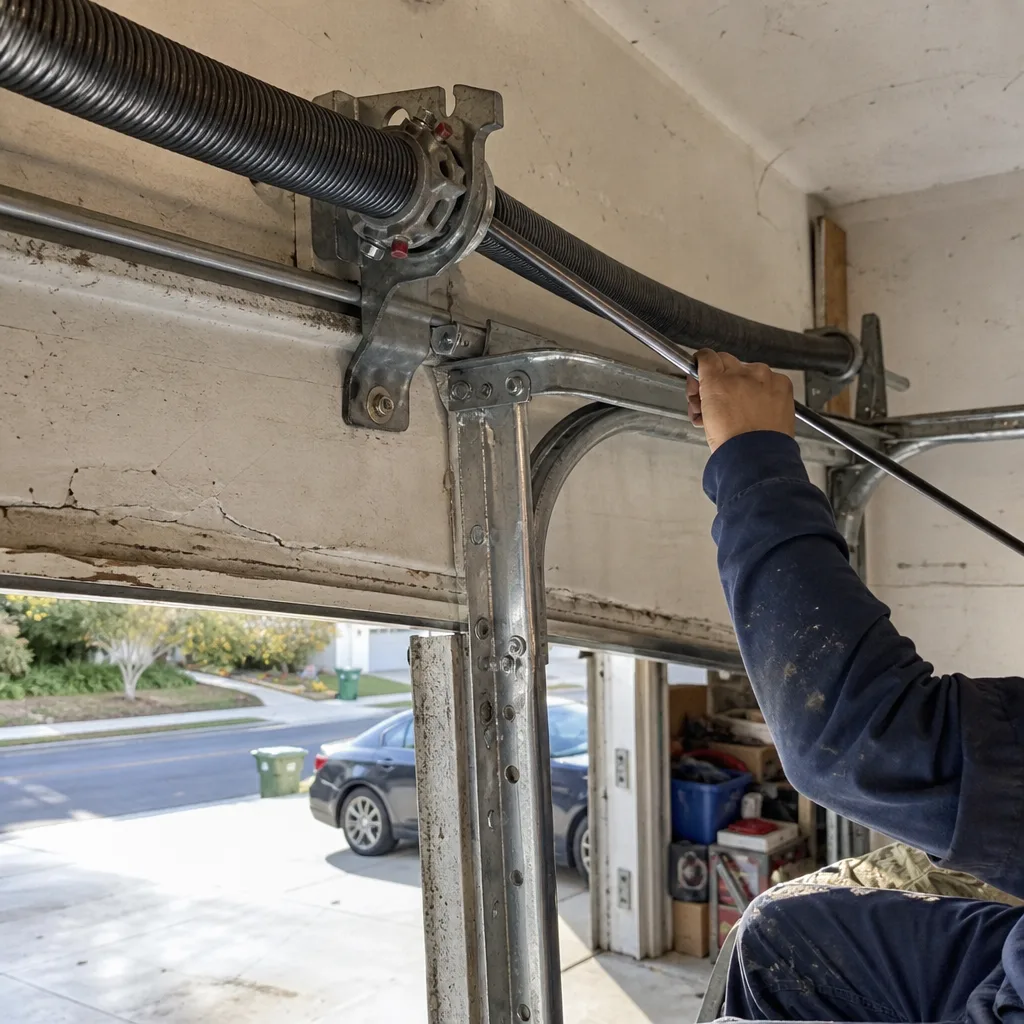 Before
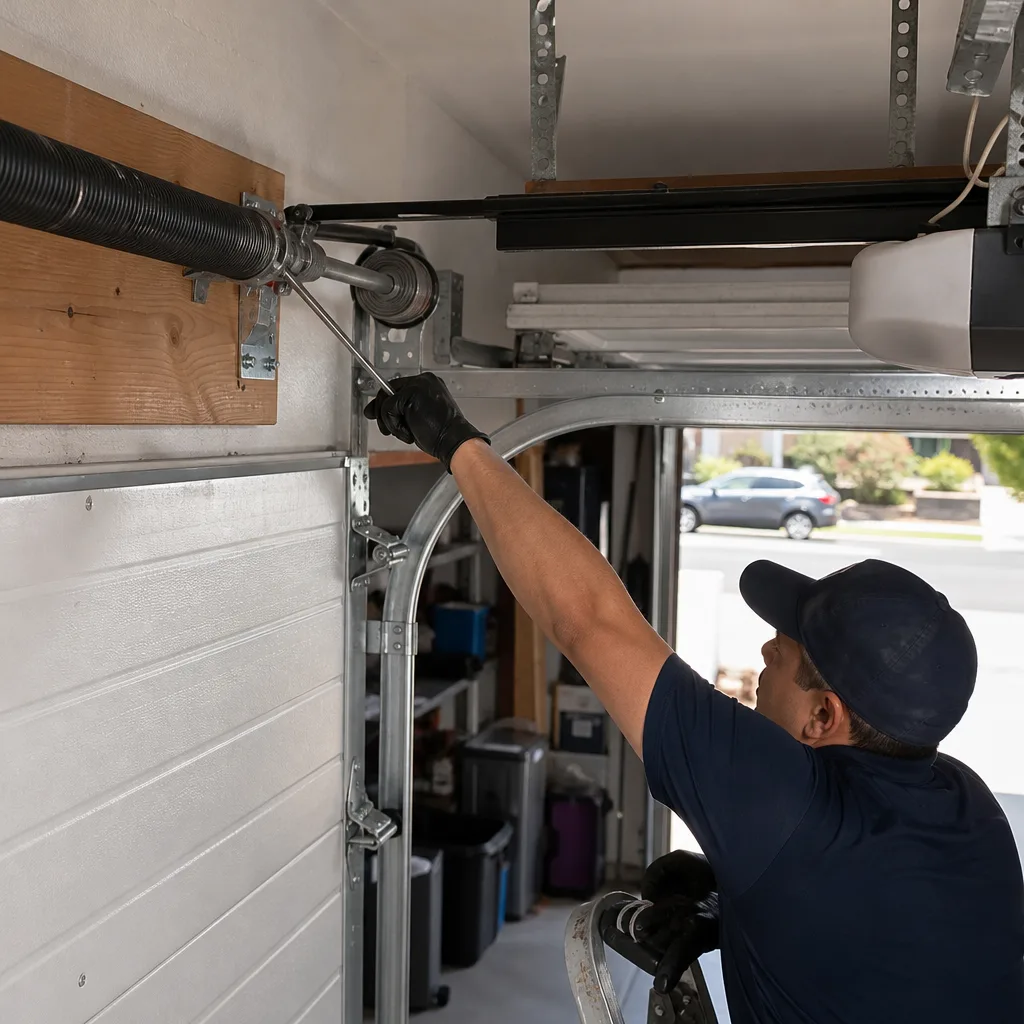 After
After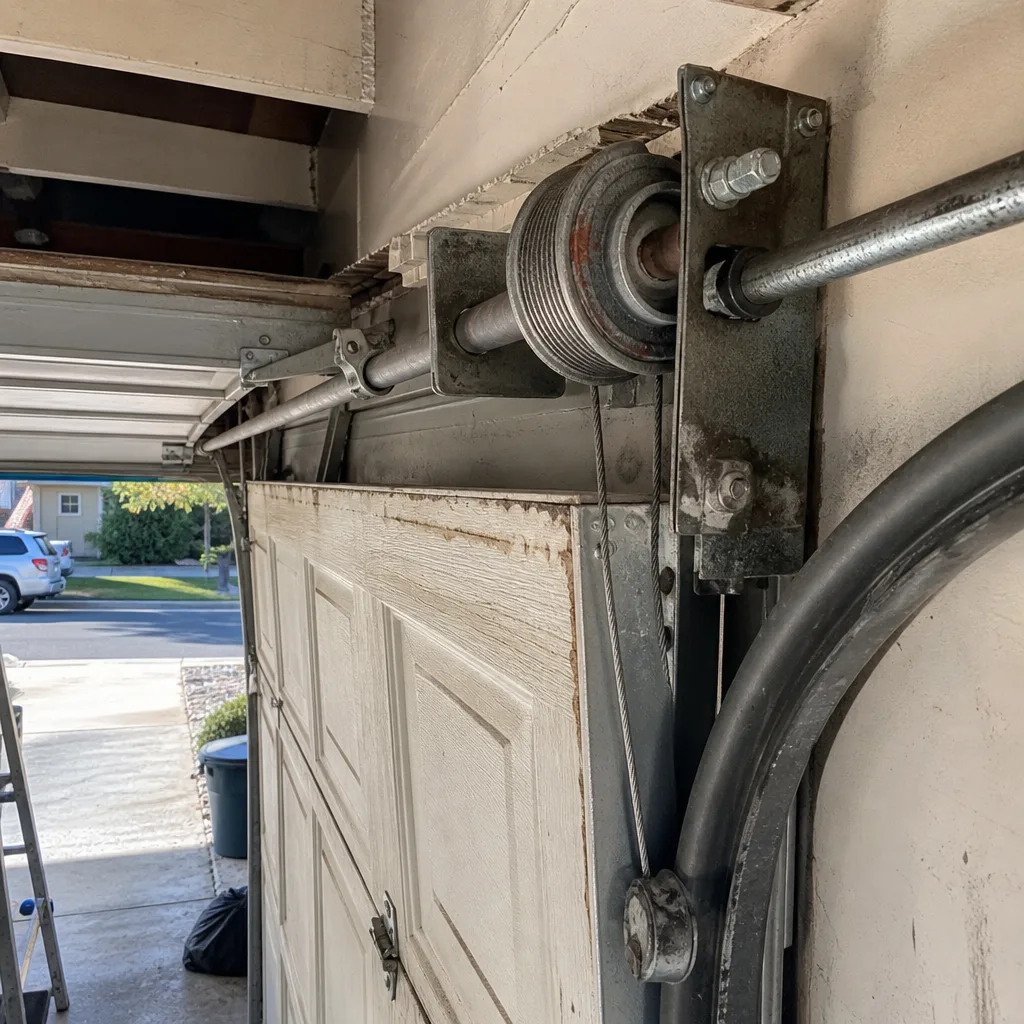 Before
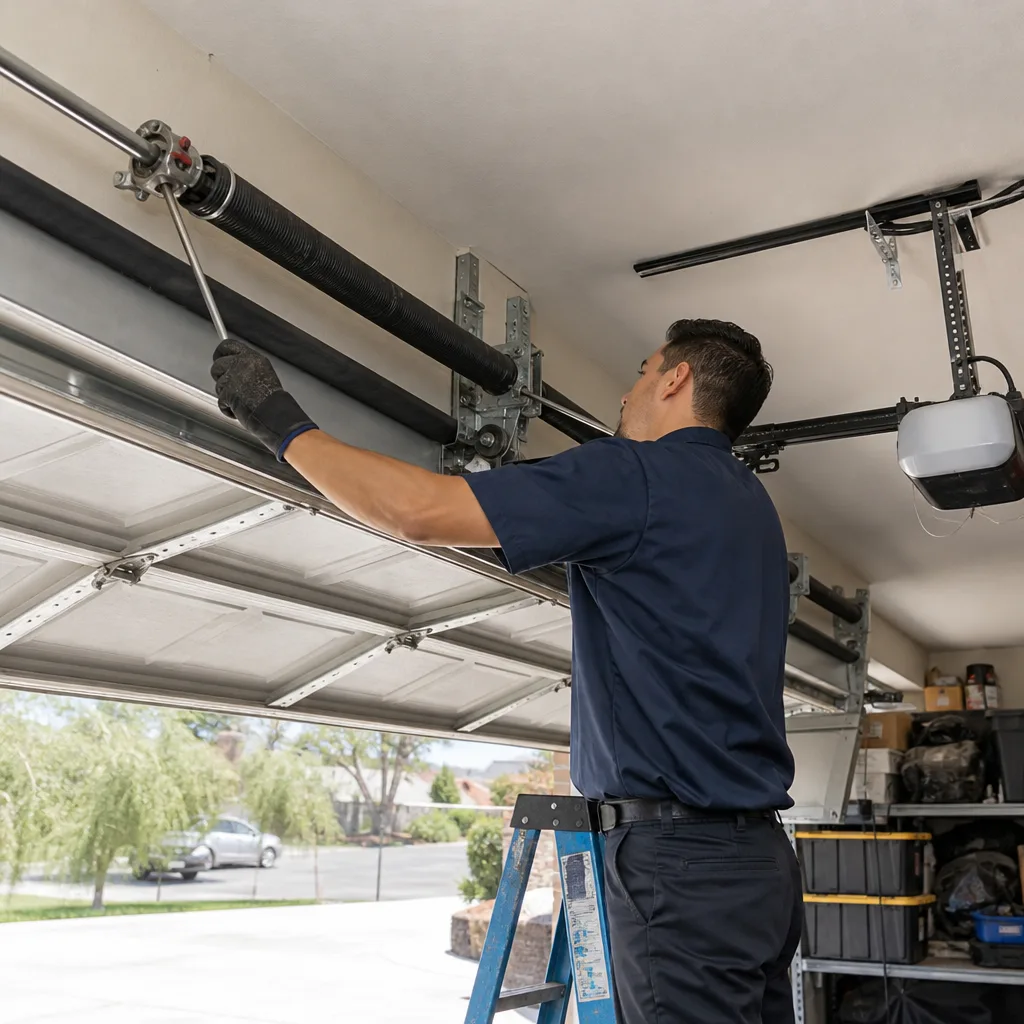 After
AfterDIY vs Professional Garage Door Cable Repair: What’s Safe to Do Yourself
A garage door cable under full tension can slice through a leather work glove like it isn’t there. The cable itself looks harmless – a twisted steel wire about an eighth of an inch thick. But the spring attached to that cable stores anywhere from 80 to 250 pounds of torque, and when a cable snaps or slips off its drum, that stored energy has to go somewhere. In Los Angeles, where single-family homes built between 1950 and 1980 still run on original extension-spring systems, we get calls every week from homeowners who started a cable repair at 9 a.m. and called us by noon with the door half-disassembled and a spring under load. This guide draws the line between what you can safely do yourself and what should never be attempted without a trained technician and the right tools, similar to the choice explored in our DIY vs Professional Garage Door: The Los Angeles Homeowner’s Decision Guide.
Quick Answer
Most Garage Door Cable Repair services are not safe for DIY. You can safely perform a visual inspection, tighten loose bottom bracket bolts, and reseat a cable keeper clip on an extension-spring system. But any repair that requires touching a torsion spring – the thick coiled spring mounted above the door – or removing a cable from a drum under tension is a job for a professional. In Los Angeles, professional cable repair typically runs $150 to $275, and a DIY mistake on a torsion-spring system can easily turn into a $600 emergency service call.
Table of Contents
- What the Garage Door Cable Actually Does
- What’s Safe to Do Yourself: The Short List
- Why Torsion Springs Change Everything
- Extension Spring Systems: A Slightly Higher DIY Threshold
- The YouTube Repair Problem Nobody Talks About
- The Honest Cost Comparison: DIY vs Professional vs Emergency
- How to Inspect Your Cables the Right Way
- Common Mistakes to Avoid
- When to Call a Professional
- Frequently Asked Questions
What the Garage Door Cable Actually Does
The lifting cables on your garage door are not decorative. They do the heavy work of transferring spring energy into door movement. Here’s the mechanical sequence: the spring – either a torsion spring mounted on a shaft above the door or a pair of extension springs running along the horizontal tracks – stores tension. The cable wraps around a drum at each end of that shaft or attaches to the bottom bracket at each lower corner of the door. When the spring releases its stored energy, the cable pulls the door upward along the track. When the door closes, the cable controls the descent and prevents the door from slamming into the ground.
On most Los Angeles homes, the door weighs between 130 and 300 pounds depending on material – wood doors are heaviest, aluminum and steel lighter. The cable is rated to handle that load repeatedly for years. But cables fray, strands snap, and eventually the cable fails. When it does, the door typically hangs crooked, jams halfway, or drops on one side. That’s the moment homeowners reach for a wrench. And that’s usually the moment the trouble starts.
What most people don’t realize is that the cable is the last link in a chain of loaded components. You can’t access the cable without being physically adjacent to the spring that powers it. And on torsion-spring systems – the most common setup on doors installed after 1990 – that spring is never unloaded unless you deliberately unwind it with the proper tools.
What’s Safe to Do Yourself: The Short List
We’re not going to tell you that every garage door task requires a technician. That would be dishonest. There are a handful of cable-related items you can handle safely, provided you follow one rule: never loosen or remove anything that is under spring tension.
Here’s the complete list of safe DIY tasks related to garage door cables:
- Visual inspection. Look at both cables from top to bottom. Check for frayed strands, rust, kinks, or flat spots where the cable has been crushed. Look at the drum above the door – the cable should wrap evenly, with no gaps or overlaps.
- Bottom bracket bolt check. At the lower corner of each door panel, the cable attaches to a bottom bracket. The bolts holding that bracket to the door can loosen over time. If you see wobble or play in the bracket, you can tighten those bolts with a socket wrench. The cable itself stays attached – you’re only tightening the bracket to the door.
- Cable keeper clip reseating on extension-spring systems only. On older doors with extension springs, a small L-shaped clip – called a cable keeper – sits in the track near the cable pulley. If the door bounces or the cable looks slack at rest, the keeper may have popped out of its slot. With the door fully open and clamped in place so it cannot roll down, you can push the keeper back into its notch. Do not attempt this on a torsion-spring system.
- Lubrication of the cable drum. A silicone-based garage door lubricant applied lightly to the drum bearing is safe as long as you don’t touch the cable or the spring. This reduces friction wear over time.
That’s the full list. Everything beyond these four items involves touching a component under load, and that’s where the risk curve goes vertical. If you’re in Los Angeles and notice anything beyond surface-level wear – heavy fraying, a cable off the drum, a door hanging unevenly – that’s the moment to pull the disconnect cord on the opener, leave the door where it is, and make a phone call.
Why Torsion Springs Change Everything
A torsion spring is the thick coiled spring mounted horizontally on a shaft above the center of your garage door. It works like a wound-up clock spring: when you open the door, the spring unwinds and releases torque through the shaft into the cable drums, which rotate and pull the cables upward. When you close the door, the process reverses and the spring winds back up.
Here’s the number that matters: a standard residential torsion spring on a 7-foot door is wound between 7 and 9 full turns from its relaxed state. Each turn stores roughly 10 to 15 pounds of linear pulling force at the cable. That means the spring is holding back a door that wants to drop with 130 to 300 pounds of force. If that spring unwinds uncontrolled – because someone removed a cable, loosened a set screw, or unbolted the spring anchor bracket without proper winding bars – it releases that energy in a fraction of a second. The steel winding cone spins at high speed. Anything in its path – fingers, wrist, forearm, face – takes the hit.
This is not theoretical. Emergency room data consistently places garage door springs among the top mechanical causes of home hand injuries, and the mechanism is almost always the same: a homeowner attempted a repair without torsion spring winding bars. The cable looks like the problem. The spring is the actual hazard.
On a torsion-spring system, the cable and the spring share the same shaft and the same drum. You cannot replace a cable without unwinding the spring. That step – unwinding – is the most dangerous part of the entire job, even for trained technicians. We use dedicated hardened-steel winding bars, leather gloves, and a locked-out door. We never improvise with screwdrivers or rebar. If you see instructions online that say you can replace a torsion cable without touching the spring, close the browser tab. That person has never done the job.
Extension Spring Systems: A Slightly Higher DIY Threshold
If your Los Angeles home was built before roughly 1985 – think ranch-style houses in the San Fernando Valley, post-war bungalows in West Adams, or mid-century homes in the San Gabriel Valley – there’s a good chance your garage door runs on extension springs, not torsion. Extension springs stretch along the horizontal tracks on both sides of the door. They look like long coils with a cable running through the center of each one.
The risk profile is different. An extension spring under load is still dangerous, but the force is linear along the track rather than rotational on a shaft. The main hazard is the spring snapping at its attachment point and becoming a projectile. That’s why modern code requires a safety cable running through the center of every extension spring – it catches the spring if it breaks and keeps it from flying across the garage.
On an extension-spring system, the DIY threshold is slightly higher. The springs can be fully relaxed with the door in the open position, provided you clamp the door to the track so it cannot roll down. Once the springs are slack, you can – in theory – unhook the cable from the bottom bracket and the S-hook, thread a new cable through the pulley, and reconnect everything. But there are still hard limits:
- Never work on extension springs without a safety cable already in place. If the safety cable is missing, stop and call a technician. You’re one snap away from a metal projectile.
- Never disconnect both springs at once. Work one side at a time. If one spring is connected and the other is loose, the door is loaded asymmetrically and can twist in the track.
- Never guess the spring tension after reassembly. Extension springs need to be matched to the door weight. If the door drifts down when you release it at head height, the spring tension is wrong and the opener will burn out prematurely.
Even on extension-spring systems, the realistic DIY success rate is low. Most homeowners get the cable on but can’t get the door balanced again. A door that won’t stay in place at mid-height is unsafe to operate, and that’s where the project stalls.
The YouTube Repair Problem Nobody Talks About
Search “garage door cable replacement” on YouTube and you’ll find dozens of videos. A confident person with a socket wrench and a stepladder replaces a cable in eight minutes, slaps the door closed, and declares victory. What those videos almost never show is the spring tension re-calibration step – the part of the job that determines whether the door operates safely after the repair.
Here’s what actually happens when you swap a cable without recalibrating spring tension:
The old cable was the correct length for the original spring setup. The new cable may be a slightly different length or diameter, or the drum may have shifted a few notches when the old cable snapped. The spring now has more or less effective turns than the door requires. The door opens too fast or too slow. It doesn’t hold at mid-height. It jerks when the opener engages. Within a few weeks, the imbalance wears out the opener gear, the new cable frays at the drum, and you’re back where you started – except now you’ve also damaged the opener.
On a torsion system, tension calibration means winding or unwinding the spring using winding bars and counting quarter-turns precisely. On an extension system, it means adjusting the spring hook position or replacing the springs with the correct rated pair for the door weight. Both procedures require a spring tension gauge or a calibrated feel for door balance. Neither is shown accurately in most online videos, because the people making those videos assume the spring is already where it needs to be.
In our experience in the Los Angeles market, the most common second visit we make is to a door where a homeowner replaced a cable from a video and the door now slams on the way down or hangs at a tilt. The cable was never the whole job. It’s one component in a balanced system, and the balance is what you can’t see in an eight-minute tutorial.
The Honest Cost Comparison: DIY vs Professional vs Emergency
Let’s put real numbers on the decision. These are Los Angeles market prices as of 2025, and they hold across most of the metro area – from Pasadena to Torrance to the Westside.
First, the DIY route. A replacement cable from a hardware store or online retailer runs $15 to $35 per cable. If you’re doing both sides – and you always should, because the other cable is the same age and under the same wear – you’re at $30 to $70. Add a pair of winding bars ($20 to $40 on Amazon, and by the way, they bend if they’re not hardened steel) and a cable puller tool if you don’t already have one. Realistic total: $50 to $110 in parts and tools, plus your time, which is realistically three to six hours if you’ve never done it before.
Now the professional route. Cable replacement on a torsion-spring door in Los Angeles typically costs $150 to $275, including both cables, drum inspection, spring tension calibration, and a door balance test. That price includes the technician’s training, insurance, and the liability if something goes wrong. It also includes a written guarantee if you’re working with the right company.
Now the emergency route – what happens when a DIY cable job goes wrong. If the spring unwinds uncontrolled, the door drops, or the cable snaps again and the door binds in the track, you’re looking at a same-day emergency call. In Los Angeles, emergency after-hours or weekend garage door service runs $250 to $600 or more, depending on what was damaged. Add the cost of the parts you already bought. Now your $50 DIY project is a $700 repair.
Here’s the math in plain terms:
- DIY with no complications: $50 to $110 in parts and tools, plus 3 to 6 hours
- Professional cable repair, both sides, done in one visit: $150 to $275, typically 45 to 90 minutes
- Emergency repair after a failed DIY attempt: $250 to $600+, plus the cost of whatever the spring damaged on its way out
The decision isn’t really about the $150. It’s about the tail risk. The cable is a $25 part. The spring attached to the cable is the thing that sends people to urgent care. That’s the number that doesn’t show up in a YouTube budget breakdown.
How to Inspect Your Cables the Right Way
Every homeowner should inspect their garage door cables twice a year – once in the spring and once in the fall, when temperature shifts in Los Angeles cause metal components to expand and contract. You can do this in ten minutes with no tools. Here’s the step-by-step:
- Close the door fully. Disconnect the opener by pulling the red emergency release cord so the door operates manually. This prevents the opener from activating while you’re looking.
- Stand inside the garage and look at both cables. With the door closed, both cables should be straight and taut, with no slack. Look for fraying – individual wire strands sticking out from the cable body. Run your eye along the full length from the bottom bracket to the drum above.
- Check the drums. At the top of the door, each cable wraps around a grooved drum mounted on the shaft. The cable should sit in the grooves cleanly, with no overlap, no crossed wraps, and no gap where the cable has jumped out of its groove.
- Check the bottom brackets. At the lower corners, the cable attaches to an L-shaped bracket bolted to the door. Look for rust, loose bolts, or a bracket that appears to be pulling away from the door panel.
- Open the door manually to half height and release it. A properly balanced door stays put or moves very slowly in either direction. If it drops sharply, the cable or spring tension is wrong. If one side sags, one cable is binding or worn.
- Look for rub marks on the track. If the cable has been scraping against the track or the header, you’ll see clean metal where the paint has worn away. That’s a sign the cable is misaligned or the drum is out of position.
If everything checks out, you can reconnect the opener and move on with your day. If you find fraying, a cable off the drum, a loose bottom bracket that won’t tighten, or a door that won’t hold at mid-height, stop using the door and call a technician. In Los Angeles, the heat and coastal moisture accelerate cable wear – doors within three miles of the ocean typically need cable attention every six to eight years, while inland doors go eight to twelve.
Common Mistakes to Avoid
- Replacing only the broken cable. Both cables were installed at the same time and have carried the same load. If one snapped, the other is close behind. Always replace cables in pairs. A mismatched set – one new, one old – pulls the door unevenly and wears the drum bearings.
- Using the wrong diameter cable. Garage door cables come in specific diameters – usually 1/8 inch for 7-foot doors and 3/16 inch for 8-foot doors, though some lighter aluminum doors use 3/32 inch. A cable that’s too thick won’t seat properly in the drum groove and will jump off under load. A cable that’s too thin will snap prematurely. Match the original specification exactly.
- Attempting a torsion cable replacement with screwdrivers as winding bars. A screwdriver or rebar is not a substitute for hardened-steel winding bars. They bend under torque, slip out of the winding cone, and leave you holding a live spring with no way to control it. This is the single most common cause of garage door spring injuries in Los Angeles emergency rooms.
- Forgetting to secure the door before starting. The door must be clamped to the track with locking pliers or a dedicated door clamp before you touch any cable on an extension-spring system. If the door rolls down while the cable is disconnected, the spring snaps back and the door drops uncontrolled. On a torsion system, the door must be in the fully open position and locked out so it cannot roll in either direction.
- Failing to recalibrate spring tension after the cable swap. This is the YouTube mistake. The cable is in, the door opens, the homeowner declares success. Six weeks later the opener is grinding and the door is sagging because the spring was never rebalanced to match the new cable length and drum position.
- Ignoring the safety cable on extension springs. Every extension spring should have a safety cable running through its center and anchored at both ends. If that cable is missing, frayed, or kinked, the spring is a projectile waiting to happen. A snapped extension spring can travel 20 feet across a garage with enough force to break bone.
- Working alone. A stuck drum or a bound cable often needs a second set of hands to hold the door steady while the other person works. More importantly, if something goes wrong, someone needs to be there to help. We never send a technician to a torsion-spring job alone, and neither should you.
When to Call a Professional
If the cable is frayed but still seated and the door still operates normally, you have time – call a professional on a regular schedule, not an emergency basis. If the cable has snapped, jumped off the drum, or the door is hanging crooked, stop using the door immediately and call. The same goes for any situation where the spring is visibly unwound, the drum is loose on the shaft, or the bottom bracket has pulled away from the door panel. A door in that condition is one cycle away from dropping suddenly, and a suddenly dropping 250-pound door is a serious hazard to anyone in its path. Garage Door Cable Repair in Los Angeles is our core service – Brock Garage Door Repair offers free estimates in Los Angeles, and we quote a written price before any work begins. Call (254) 602-5116.
Frequently Asked Questions
No. Replacing a garage door cable requires working directly with the spring system, and on most modern doors that means a torsion spring under 7 to 9 turns of stored torque. The cable swap looks simple, but the spring is the hazard, and you cannot access one without exposing yourself to the other. In Los Angeles, we recommend professional cable replacement on any torsion-spring door and careful limitation of DIY work on extension-spring doors.
Professional garage door cable repair in Los Angeles typically runs $150 to $275 for both cables, including spring tension calibration and a door balance check. Emergency same-day service runs $250 to $600 or more depending on the time and extent of damage. DIY parts cost $30 to $70 for both cables, plus tools, but the risk-adjusted cost is often much higher. Call (254) 602-5116 for an exact quote – estimates are free and the price is in writing before we start.
No, not on a torsion-spring system. The cable wraps around a drum mounted on the same shaft as the torsion spring. To remove and replace the cable, you must unwind the spring, remove the drum, and rewind the spring to the correct turn count. There is no way around that sequence. Anyone who suggests otherwise is describing a procedure that will leave the door unbalanced and unsafe.
When a cable snaps while the door is open, one side of the door loses its lifting connection and the door drops on that side. The result is a door jammed diagonally in the track, usually with one bottom corner on the ground and the other still elevated. If the door falls far enough, it can pull the track from the wall. Do not attempt to move the door manually. Disconnect the opener and call a technician.
Garage door cables in Los Angeles typically last 8 to 12 years depending on proximity to the coast, frequency of use, and whether the door is regularly lubricated. Coastal properties in neighborhoods from Santa Monica to Long Beach see faster cable wear from salt air, with failures at 6 to 8 years being common. If your cables are older than a decade, inspect them monthly and budget for replacement.
Not with Brock Garage Door Repair. We quote a written price before any work starts, and the number on your invoice matches the number you approved. The only way the price changes is if you approve additional work – like replacing a worn drum or a binding pulley – and even then, the new price is quoted and agreed before we touch it. Call (254) 602-5116 to schedule an estimate.
The Bottom Line
The garage door cable looks like a simple part, and in isolation it is. But the cable does not exist in isolation. It shares a shaft, a drum, and a load path with a spring that stores enough energy to cause life-changing injury. That’s the line between safe DIY and work that belongs in professional hands: you can inspect, tighten, and reseat. You should not replace, unwind, or recalibrate. The cost of doing it right in Los Angeles is $150 to $275. The cost of doing it wrong has no ceiling. If your cables are worn, frayed, or off the drum, call a professional. Get a written price. Don’t become the emergency call. For more guides & resources on keeping your garage door safe, visit our blog.
Written by Wade Mercer, Owner at Brock Garage Door Repair, serving Los Angeles since 2001.