
Last updated October 9, 2026
Full 25-point door and opener safety check with every visit - springs, cables, rollers, tracks, and your LiftMaster or Chamberlain opener included
You get a price before we start. It does not change when the truck arrives.
 Before
 After
After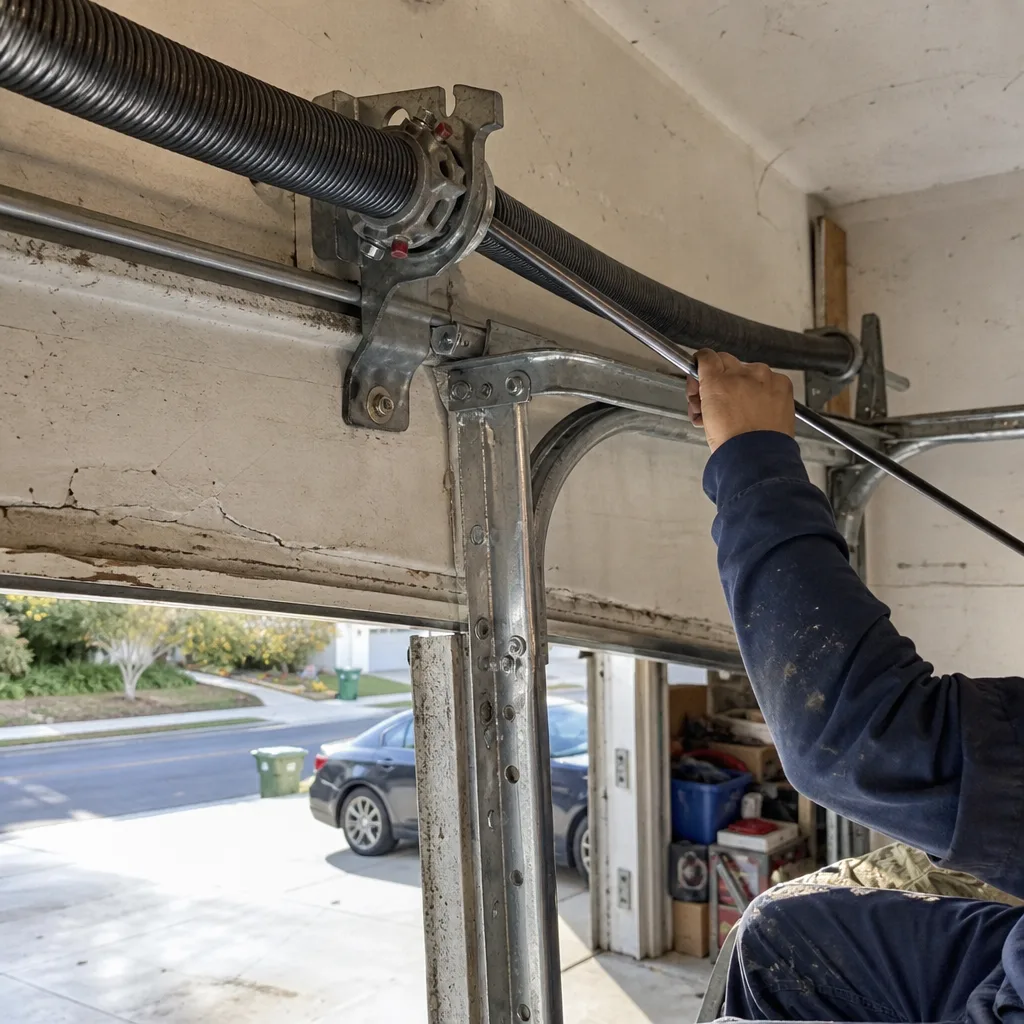 Before
 After
After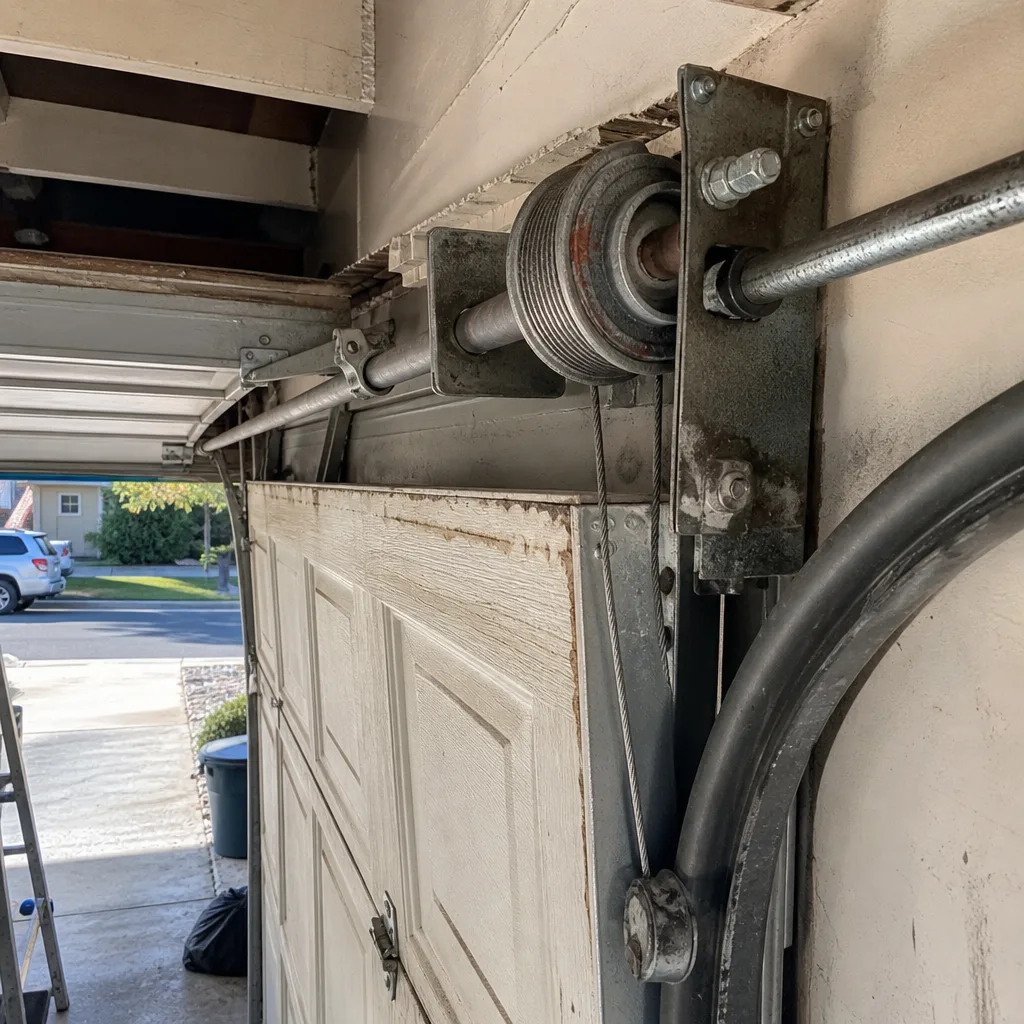 Before
 After
AfterGarage Door Opener Repair Warning Signs Every Homeowner Should Know
A grinding noise during the last six inches of travel is not the same problem as a grinding noise at mid-lift, but most guides treat them identically. Location and timing of symptoms matter more than the symptom itself. In Los Angeles, where garage doors cycle more than twice the national average because most homes use the garage as the primary entry point, opener failures follow predictable patterns. This guide ranks the warning signs by urgency, explains what each one actually means, and tells you what to document before you pick up the phone.
Quick Answer
The warning signs that matter most are: grinding or squealing that has changed pitch or location in the last month, a door that reverses mid-cycle without touching anything, a remote that works from 10 feet but not 20, and an opener that runs but won’t move the door. Any of these four means the opener needs Garage Door Opener Repair within days, not weeks. Ignoring them typically leads to a full stop when the door is half open, which strands your car and compromises your home’s largest entry point.
Table of Contents
- Tier One: Stop Using the Door Today
- Tier Two: Schedule Service Within the Week
- Tier Three: Watch, Log, and Act If It Worsens
- Why Intermittent Failures Tell You More Than Constant Ones
- Opener Problems vs. Spring and Cable Problems: How to Tell Them Apart
- What to Document Before You Call a Technician
- What Your Opener Brand Tells You About the Repair
- Los Angeles Context: Climate, Cycles, and What We See Most
- Common Mistakes to Avoid
- When to Call a Professional
- Frequently Asked Questions
- The Bottom Line
Tier One: Stop Using the Door Today
Some sounds and behaviors mean a component is failing in a way that can cause the door to drop or the opener to seize while the door is in motion. In our experience across thousands of Los Angeles service calls, these are the signs that precede a door coming off its tracks or a gear stripping completely. If you notice any of these, unplug the opener and use the manual release cord to operate the door by hand until a technician arrives.
- Metal-on-metal grinding that has changed pitch in the last week. This is usually the drive gear inside the opener stripping. On LiftMaster and Chamberlain chain-drive models, the nylon gear is designed to wear out before the motor does, but when it goes, the door stops mid-lift. The sound gets progressively worse fast.
- A door that reverses on its own without touching anything. If the door starts closing, hits nothing, and reverses back up, the force settings or the safety sensor alignment are off. A door that reverses without obstruction is not obeying its own safety logic, which means the next failure could be a door that closes when it shouldn’t.
- The opener runs but the door doesn’t move. A humming motor with a stationary door usually means the coupler between the motor and the gear shaft has sheared. This is common on older Craftsman and Raynor units. The motor overheats pushing against a stripped connection, and you get a burn smell from the head unit.
- The door drops two or three inches after stopping. An opener that can’t hold position is failing at the limit switch or the chain tension. On a door over 400 pounds, that drift means the opener is no longer in control of the door’s weight.
- A burning smell from the head unit. That’s the capacitor or the motor windings overheating. Either way, continued use turns a repairable part into a burned-out motor, which is a full opener replacement, not a repair.
Los Angeles garages often sit under living space or bedrooms, so an opener that’s grinding at 6:30 a.m. is not just a mechanical problem, it’s a household problem. The fix is usually fast and done same-day, but only if you stop running the door first. Continuing to cycle a failing opener for another week is how a $120 gear repair becomes a $450 logic board and motor replacement. For details on how we handle opener repairs across the city, see Garage Door Opener Repair in Los Angeles.
Tier Two: Schedule Service Within the Week
These signs don’t mean the door will fail tonight, but they mean a component is degrading. If you’re in Los Angeles and you park in the garage daily, you’ll hit a failure within a month or two. Schedule the repair before the door strands you.
- The opener light stays on longer than it used to or flickers intermittently. On LiftMaster models, the light staying on after the cycle completes can indicate a logic board starting to fail. The board controls the light timer, the travel limits, and the force settings. When the light behaves oddly, the board is often the next thing to go.
- The remote range shrinks over weeks, not days. A range that was 30 feet and is now 8 to 10 feet suggests the receiver board in the opener is degrading, or the capacitor that powers the radio is failing. Shrinking range over weeks is almost never a battery issue. A fresh battery that still gives you short range points to the opener, not the remote.
- The door starts and stops during travel. Hesitation mid-cycle, a door that jerks, or one that pauses for a half-second before continuing, often means the travel module or the capacitor is failing. The capacitor gives the motor its starting jolt. When it weakens, the door stutters.
- A single beep or a clicking sound from the wall console. On Chamberlain and LiftMaster units with diagnostic beep codes, a beep that isn’t accompanied by a flashing light pattern you can decode is still worth attention. Clicking relays in the wall console can mean the logic board is cycling power incorrectly.
- The door moves slower than it did six months ago. Slower operation, especially in one direction, is the opener motor losing torque or the chain stretching. Los Angeles garages see more chain stretch than almost anywhere because doors cycle so often.
These are the calls we get most often in Los Angeles: a door that still works, but the owner knows something feels wrong. Trust that. The difference between a Tier Two repair and a Tier One emergency is usually two to three weeks of ignoring a change you already noticed.
Tier Three: Watch, Log, and Act If It Worsens
Some signs are normal wear, not failure. But you need to know which is which, and you need to track the change. The rule in Los Angeles is simple: if a sound or behavior is the same as it was a year ago, log it and move on. If it’s changing, act.
- A consistent, low-level hum during travel. Every chain-drive opener hums. Belt-drive units are quieter. If the hum has been present since the opener was installed and hasn’t changed pitch or volume, that’s the motor operating normally.
- A single clunk when the door starts moving. Most chain-drive openers clunk once when the carriage engages. If it’s one clunk, every time, at the same point, and the door moves smoothly after, that’s drivetrain slack releasing, not failure.
- A door that’s slightly louder on cold mornings. In Los Angeles, the temperature swings are mild, but even a 15-degree morning change makes metal parts contract. A door that’s noisier on a cold morning and quiet by afternoon is metal expanding and contracting, not a failing opener.
- The remote works from 20 feet but not from inside the house. That’s usually RF interference or a weakened remote battery. If the range is stable at 20 feet and the garage has a metal door or a refrigerator near the wall console, the signal is being blocked, not failing.
What we tell Los Angeles homeowners is to log what they hear and see once a month; for more guides & resources on tracking these changes, see our full checklist. Note the sound, where in the cycle it happens, and whether the door’s speed changed. If a sound moves to a different part of the travel or gets louder over 30 days, that’s not watch-and-log anymore, that’s Tier Two. The shift from stable to changing is the diagnostic line.
Before wrapping this section, we should clarify how we approach repairs in Los Angeles. We operate on a written-price-first basis and back every opener repair with a 365-day guarantee. You can read more about our general repair standards on the Brock Garage Door Repair home page.
Why Intermittent Failures Tell You More Than Constant Ones
An opener that fails every time is easy to diagnose. An opener that fails sometimes, under specific conditions, is harder, but the pattern tells you more. Intermittent failures in garage door openers come from three places, and each one behaves differently.
Logic board failures are the most common intermittent culprit in Los Angeles. The board’s soldered connections expand and contract with temperature, so the failure appears when the garage is hot (midday or after the afternoon sun hits the garage door) and disappears when it cools. If your opener refuses to respond only on hot afternoons, or only after the door has been sitting in direct sun for hours, suspect the board. A board that’s starting to fail often works fine in the morning and acts up in the late afternoon.
Capacitor failures are easier to spot. The capacitor stores the jolt that starts the motor. When it’s failing, the door may fail to start on the first click, then work fine on the second or third try. You’ll hear a click, nothing moves, then another click and the door starts. That’s the capacitor not holding enough charge to fire the motor on the first attempt. It’s most common on openers older than 10 years, and in Los Angeles, where doors cycle more often, capacitors wear faster.
RF interference is the intermittent failure that has nothing to do with the opener. In Los Angeles, we see this in neighborhoods with LED streetlights, newer weather stations, or neighbors with ham radio gear. The remote works perfectly 90% of the time, then fails for an afternoon, then works again. If the wall console always works but the remote only fails sometimes, that’s RF, not a mechanical issue. The fix is usually a receiver board swap or a frequency change on the opener.
The takeaway: when the failure is random, log the conditions. Note the temperature, the time of day, and whether the wall console worked when the remote didn’t. That log turns a random problem into a diagnosable one, and it saves the technician an hour of bench-testing parts that aren’t broken.
Opener Problems vs. Spring and Cable Problems: How to Tell Them Apart
The most common misdiagnosis we correct in Los Angeles is a spring or cable problem being blamed on the opener. These are separate systems, and the repair path is different. Here’s how to tell them apart in 60 seconds.
If the door opens a few inches and stops, but the opener keeps running, that’s a spring problem, not an opener problem. The opener is trying to lift a door that its springs normally balance. When a torsion spring breaks, the door becomes a dead weight, and the opener can’t move it. You’ll hear the opener motor straining, but the door won’t rise. The opener is fine. The spring isn’t.
If the door moves smoothly but won’t fully open or close, that’s an opener travel limit issue. The limits tell the opener where to stop. They drift over time, especially on older Chamberlain and LiftMaster units. The fix is a limit reset, which a technician can do in about 20 minutes.
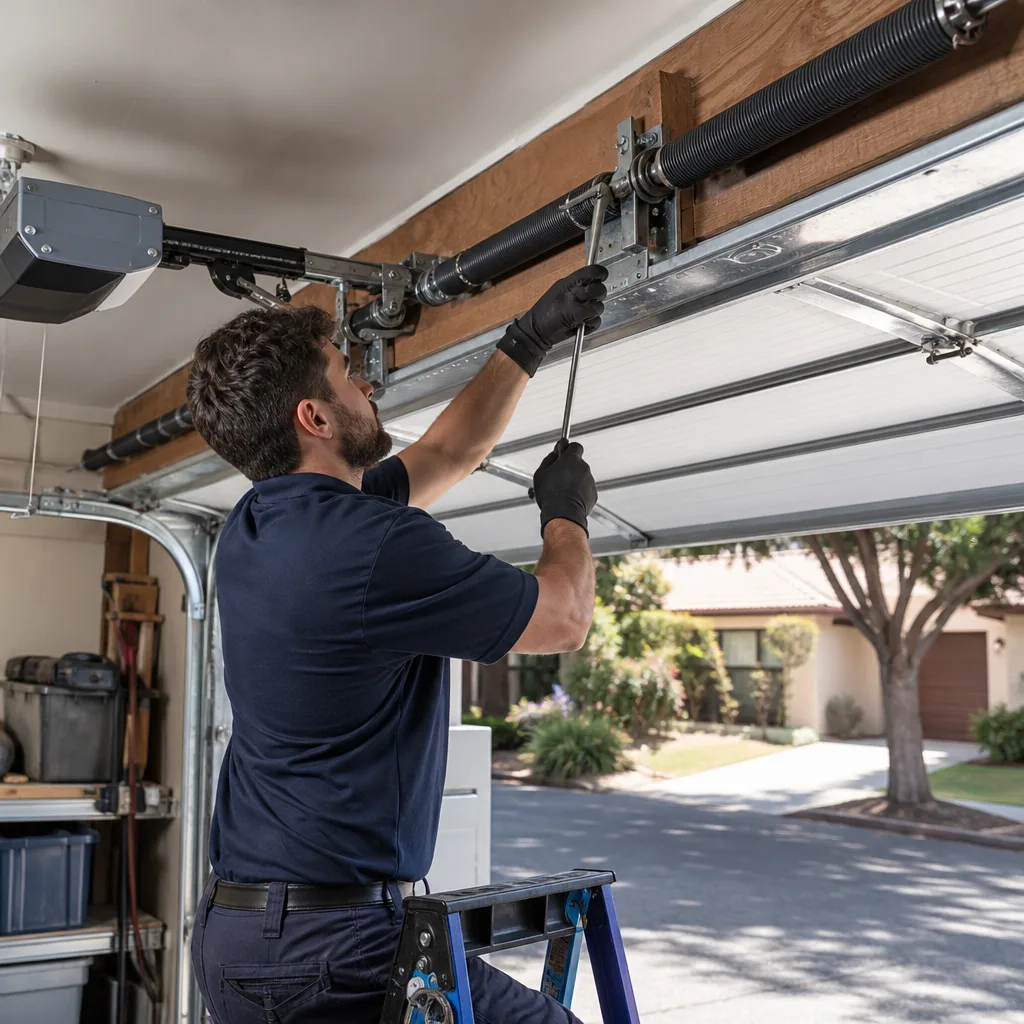
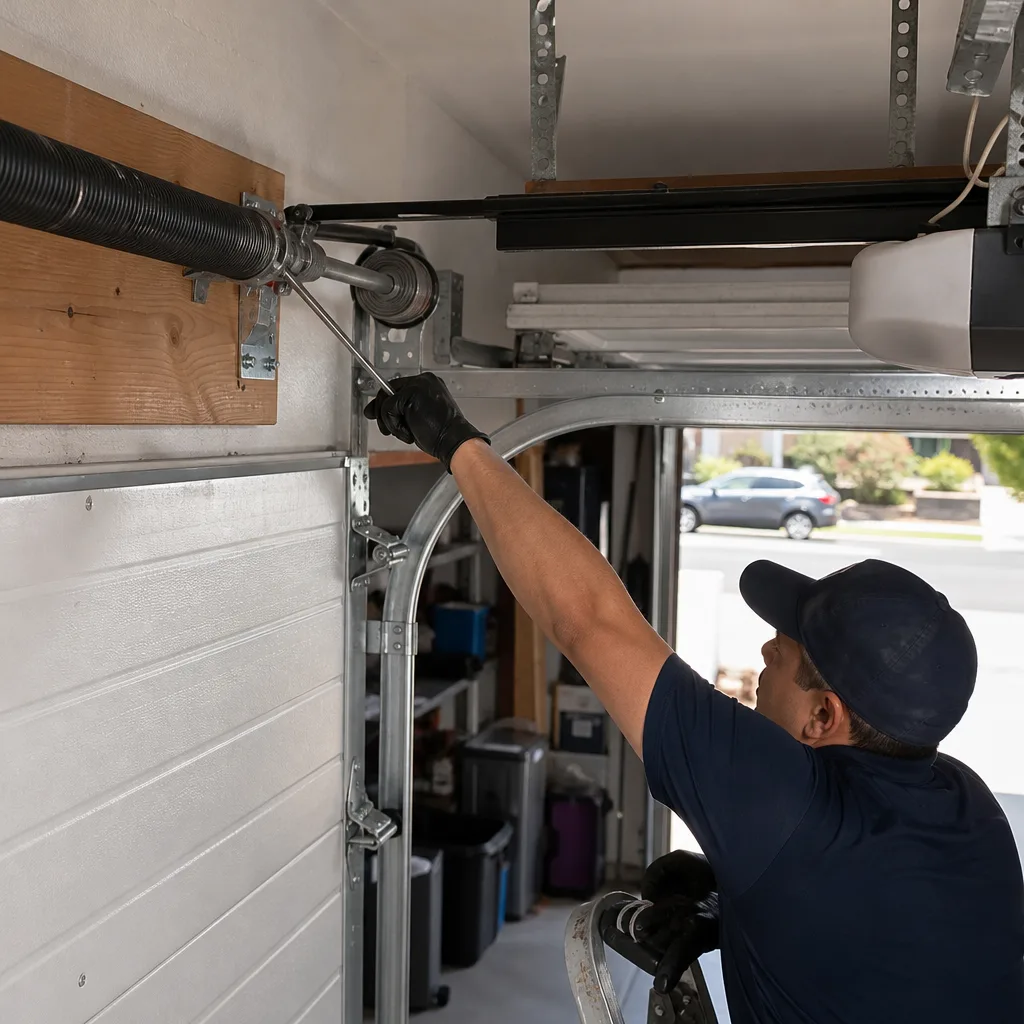
If you hear a loud bang like a gunshot from inside the garage, that’s a torsion spring snapping. Not an opener problem. The spring, which is the thick coiled metal mounted above the door, bears most of the lifting load. When it snaps, the door won’t move more than six inches, and the opener sounds like it’s grinding because it’s pushing against the door’s full weight. Do not attempt to open the door manually. A broken spring is under tension and dangerous to handle without training. This is a cable and spring repair, and you should call a professional. For details, see Garage Door Cable Repair in Los Angeles.
If the door is crooked or hanging unevenly in the tracks, that’s a cable issue. The cables run alongside the door and work with the springs to keep the door level. When a cable frays or snaps, the door tilts. Opening it further can pull the door off the tracks. Stop and call a professional, because a door off its tracks is a far bigger job than a cable replacement.
If the opener runs smoothly but the door vibrates or shakes during travel, that’s usually a roller or track problem, not the opener. The opener’s moving fine. The door is fighting something. Most of the time it’s a worn roller or a track that’s out of alignment.
The point: don’t replace an opener because a spring broke. We see that in Los Angeles more often than we should, and it’s an expensive mistake. Isolate the problem first, and if you’re not certain, call a technician who will diagnose before quoting. For the broader picture on repair work in Los Angeles, see Garage Door Repair in Los Angeles.
What to Document Before You Call a Technician
Most homeowners call and say, “The door’s making a weird noise.” That gives the technician nothing to work with. Here’s what to capture before you call, and it takes about five minutes. The goal is to cut down diagnostic time and avoid misdiagnosis, which means a smaller invoice and a faster fix.
- Record a 10-second video of the door cycling. Stand inside the garage, about eight feet from the door, and record one full open and close cycle. Capture the sound and the door’s movement. A technician who hears the noise before arriving usually knows the problem before knocking.
- Note the temperature and time of day when the failure happens. If the opener fails only on hot afternoons, that’s a different fix than if it fails every morning. In Los Angeles, where afternoon garage temperatures can hit 110 degrees in summer, heat-related failures are common and specific.
- Count how many cycles before the failure repeats. If the door works fine for three cycles and fails on the fourth, write that down. If it fails only after sitting closed for hours, that’s a different diagnostic path than failing after immediate use.
- Test the wall console separately from the remote. Stand by the wall console and press the button. Then stand outside with the remote and try it. Whether both work or only one works is the single most important diagnostic data point.
- Note the opener’s brand and approximate age. Look for the brand name on the head unit. If you know when it was installed, write that down. A 20-year-old LiftMaster and a 5-year-old Chamberlain have very different likely failure points.
- Write down the last time you replaced the remote battery. A remote that was last battery-fed 18 months ago is a different problem than one with a fresh battery. If you replace the battery and the range is still short, you’ve eliminated the cheapest variable.
We use this information on every call. It means the technician arrives with the right parts on the truck, and the diagnostic time is cut in half. In Los Angeles, where traffic can add an hour to a parts run, that’s the difference between a one-visit repair and a two-visit one.
What Your Opener Brand Tells You About the Repair
Different brands fail in different ways, and if you know your brand, you can usually predict the failure. Our technicians are trained on eight major brands, including LiftMaster, Wayne Dalton, Craftsman, and Raynor, so the right fix is applied to your specific system, not a generic workaround.
LiftMaster and Chamberlain are the most common in Los Angeles. They share the same parent company and many internal components. The most frequent repair we make on these units is the gear and sprocket assembly, a nylon gear that strips after about 10 to 12 years of use. The second most common is the logic board. Both are repairable in one visit.
Craftsman openers, especially units from the 1990s and early 2000s, have a reputation for capacitor failure. The capacitor provides the starting jolt, and when it goes, the opener clicks but doesn’t move. The good news is capacitors are inexpensive and the repair is quick. The bad news is Craftsman has moved through several manufacturer relationships over the years, so parts availability varies.
Wayne Dalton openers are less common in Los Angeles but appear regularly in homes built in the 2000s. They tend to have power head issues, specifically the motor mount and the drive sprocket. When a Wayne Dalton opener fails, it often fails mid-cycle with a loud metallic sound.
Raynor openers have a loyal following and a good track record. The most common Raynor failure we see is the travel limit module drifting, which means the door stops at the wrong point. That’s a simple adjustment, not a parts replacement.
If you don’t know your opener’s brand, look at the head unit. The name is printed on the housing. If you’re still not sure, a technician can identify it in seconds. Knowing the brand before you call means the right parts arrive on the first visit, not after a return trip across Los Angeles.
Los Angeles Context: Climate, Cycles, and What We See Most
Los Angeles is a unique market for garage door openers. We see patterns here that don’t appear in most other cities, and they’re worth knowing because they change how you should interpret a warning sign.
Cycles per day are higher than almost anywhere. In Los Angeles, the garage is the primary entrance for most homes. People leave for work through the garage, come home through the garage, run errands through the garage. A door that cycles eight to ten times a day has a much shorter lifespan than a door that cycles twice. That’s why openers that would last 20 years in a Midwestern suburb last 12 to 14 years here. When a Los Angeles homeowner says their opener is “acting up,” the remaining life is usually shorter than the national average.
Coastal salt air accelerates corrosion. If you live within five miles of the coast, the salt in the air corrodes the opener’s circuit board contacts and the metal in the drive components. We see more corrosion-related logic board failures in coastal neighborhoods like the South Bay and the Westside than anywhere else in the city. A board that fails from corrosion often has intermittent symptoms: working fine for days, then failing for an afternoon.
Inland heat pushes capacitors and boards harder. In the San Fernando Valley and further east, garage temperatures in summer regularly exceed 120 degrees. That heat breaks down the electrolytic capacitors in the opener. A capacitor that’s been baking at 120 degrees for five summers is going to fail while a coastal capacitor of the same age is still fine. Heat-related failures spike every August and September in Los Angeles.
The hilly terrain changes travel limits. Los Angeles homes with driveways on a slope put different stress on the opener than flat-lot homes. The door on a sloped driveway often needs different travel limit settings, and we see drift in those settings more often in hillside neighborhoods. If your door stops a half-inch short of the ground and your driveway has a noticeable slope, that’s often a limit-setting drift, not a mechanical problem.
What this means for you: a Los Angeles homeowner should act on opener warning signs a little earlier than someone in a cooler, flatter, lower-cycle city. The margin for error is smaller here. If your opener has been making a new noise for two weeks, schedule the call now, not next month.
Common Mistakes to Avoid
- Continuing to use a door that’s making a new grinding noise. That grind is metal removing metal. Every cycle makes the repair bigger. What starts as a gear replacement becomes a motor replacement if you keep running the door for another month.
- Replacing the remote when the problem is the opener’s receiver. If a new battery and a new remote don’t fix the range, the receiver board inside the opener is the problem. Buying a third remote is just spending money on a part that wasn’t broken.
- Adjusting the travel limits without knowing the force settings. Travel limits and force settings work together. Changing one without checking the other can make the door close too hard, which is a safety risk. Leave limit adjustments to someone who knows the relationship.
- Blaming the opener when the spring is broken. A door that opens six inches and stops while the opener motor runs is a broken spring, not a failed opener. Replacing the opener won’t fix it, and now you’ve spent money on the wrong repair.
- Ignoring an opener light that won’t turn off or won’t stay on. The light circuit is controlled by the logic board. When it misbehaves, the board is often next in line. It’s a cheap diagnostic clue that people write off as a bulb issue.
- Lubricating the opener motor to fix a grinding noise. Grease on the drive gear masks the sound for a week, but the gear is still failing. Worse, the grease attracts dust and grit, which accelerates the wear. A grinding gear needs replacement, not lubrication.
- Waiting until the door fully fails before calling. Los Angeles traffic and parts availability mean a planned repair during daylight hours is always faster and cheaper than an emergency call at 9 p.m. when the door won’t close and your garage is open to the street.
When to Call a Professional
If the door is making a noise that’s changed in the last month, if it reverses without obstruction, if the remote range has shrunk, or if the door won’t hold position, call a professional. These are not DIY fixes, and in the case of a door that’s drifting or reversing on its own, the safety risk is real. An opener that doesn’t close properly leaves your home open to the street all night in a city like Los Angeles.
Brock Garage Door Repair offers free estimates in Los Angeles. Call (254) 602-5116, and a live person answers, 24 hours a day, seven days a week. We’ll give you a written price before any work starts, and every repair carries a 365-day guarantee in writing. If a covered repair fails within that year, we come back and fix it at no charge.
Frequently Asked Questions
Most opener repairs in Los Angeles run between $150 and $350, depending on the part. A gear and sprocket replacement typically falls in the $180 to $280 range, a capacitor replacement usually runs $120 to $200, and a logic board replacement can run $250 to $400. The price is always quoted in writing before any work begins, so you’ll never see a number on the invoice that you didn’t approve first. Call (254) 602-5116 for an exact quote based on your opener’s brand and symptoms.
Most openers under 15 years old can be repaired. The most common failures are gears, capacitors, and logic boards, all of which are replaceable parts. If the opener is over 20 years old and the motor has failed, replacement is usually the better option because a new motor costs more than a new opener. The decision depends on the specific failure and the opener’s age.
Intermittent failures are usually a logic board, a capacitor, or RF interference. A logic board that’s failing typically acts up when the garage is hot. A capacitor that’s failing typically makes the door fail on the first try and work on the second. RF interference causes the remote to fail randomly while the wall console always works. Log the temperature and time of day when the failure happens, and that log will tell the technician which one you’re dealing with.
No. A grinding noise means metal is cutting into metal, and every cycle makes the damage worse. Unplug the opener, use the manual release cord to operate the door by hand, and call a professional. The cost of a repair caught early is a fraction of the cost of a full replacement after the gear strips and the motor burns out.
In Los Angeles, most garage door openers last between 10 and 14 years, shorter than the national average of 15 to 20 years. The higher cycle count, coastal corrosion, and inland heat all shorten lifespan. If your opener is over 10 years old and showing warning signs, a repair is usually still worth it for a single component failure, but a second or third failure in the same unit is a signal that replacement is more cost-effective.
Our technicians are trained on eight major brands, including LiftMaster, Chamberlain, Genie, Clopay, Amarr, Wayne Dalton, Craftsman, and Raynor. That matters because each brand has its own failure patterns and parts. A generic repair applied to the wrong brand often fails within months. We diagnose the specific brand and apply the fix that matches the system. For a quote on your specific opener, call (254) 602-5116.
The Bottom Line
Most garage door opener failures in Los Angeles announce themselves weeks before they strand you. The signs are there: a new grinding noise, a door that reverses without reason, a remote that’s losing range, an opener light that won’t behave. The key is knowing which tier a sign falls into and acting on it. Stop the door today for grinding, reversal, or a door that drops. Schedule within the week for shrinking range, stuttering travel, or odd lights. Log and watch for stable sounds that haven’t changed. Document what you see before calling, and you’ll get a faster diagnosis and a smaller invoice. When you’re ready, the phone number is (254) 602-5116. A real person answers, and the price comes in writing before any work begins.
Written by Wade Mercer, Owner at Brock Garage Door Repair, serving Los Angeles since 2001.