
Last updated October 9, 2026
Full 25-point door and opener safety check with every visit - springs, cables, rollers, tracks, and your LiftMaster or Chamberlain opener included
You get a price before we start. It does not change when the truck arrives.
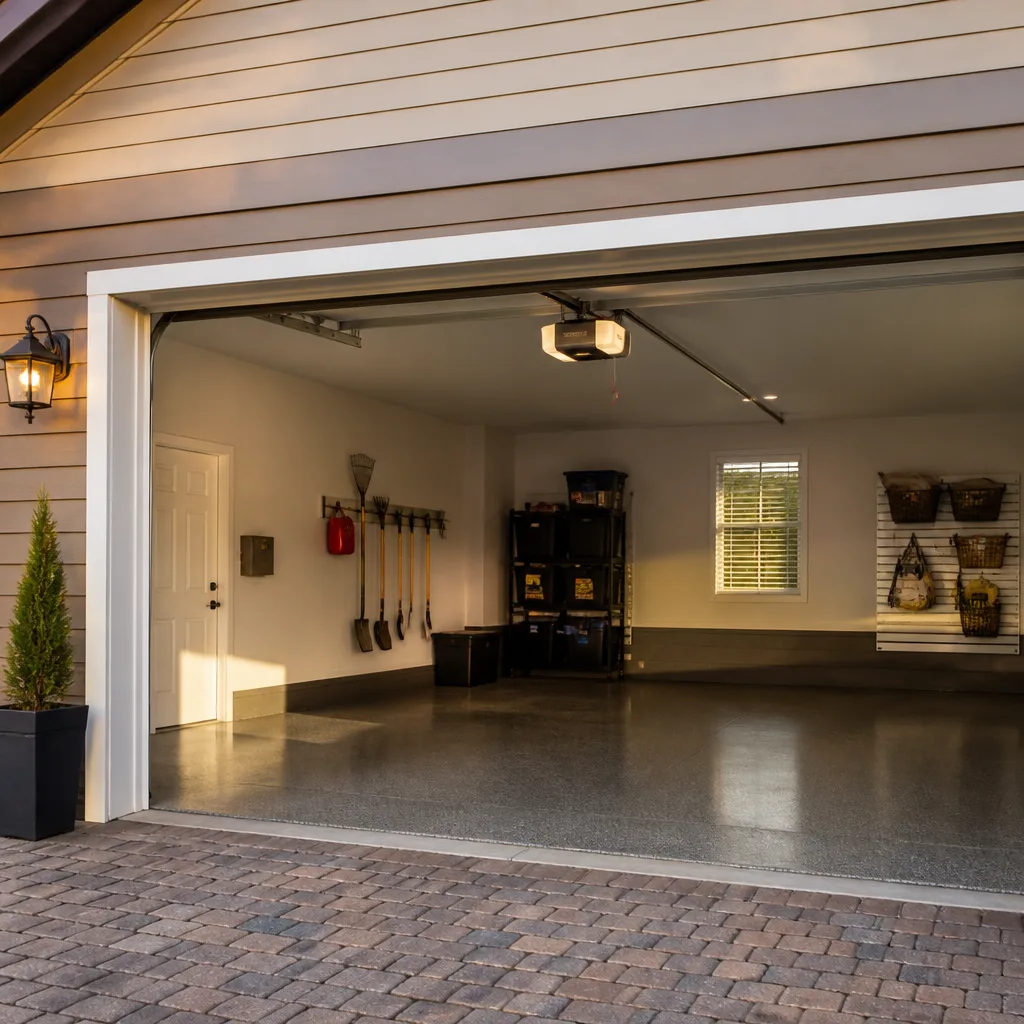
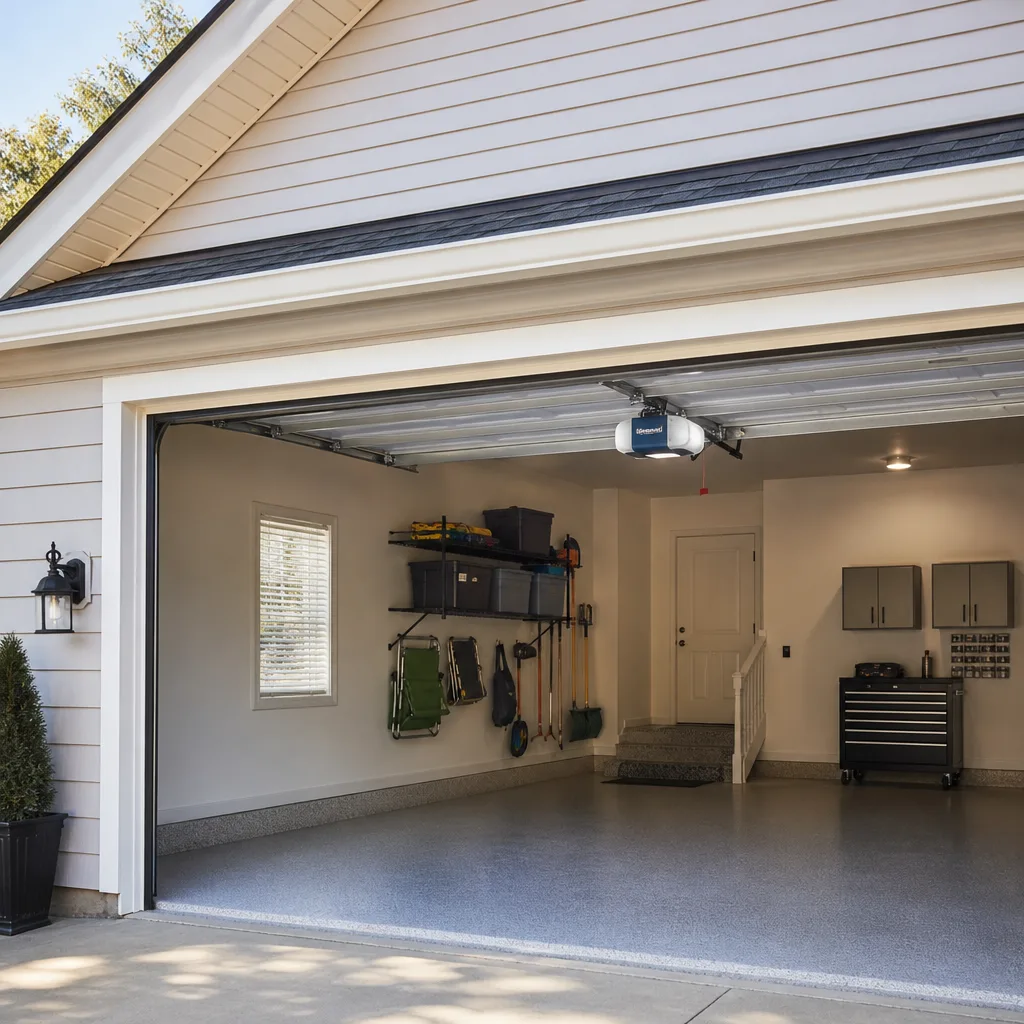
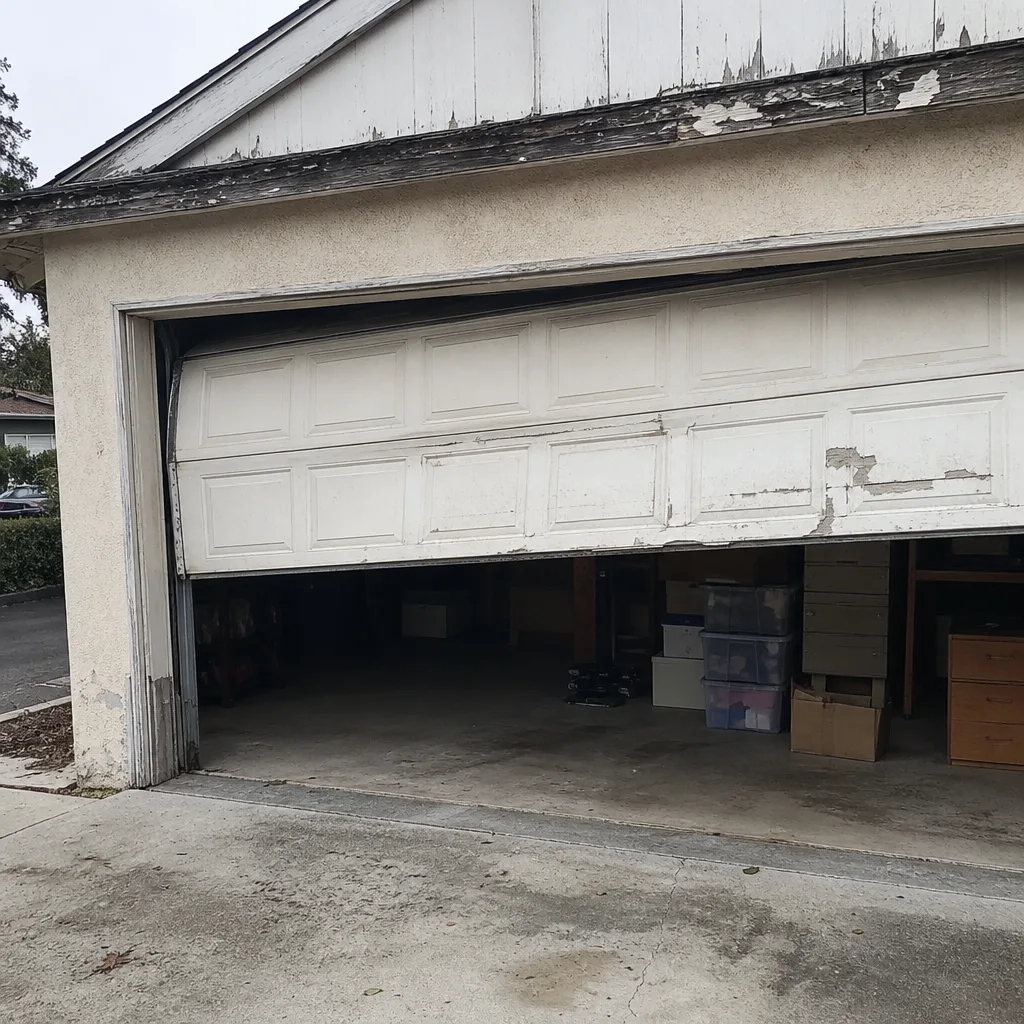 Before
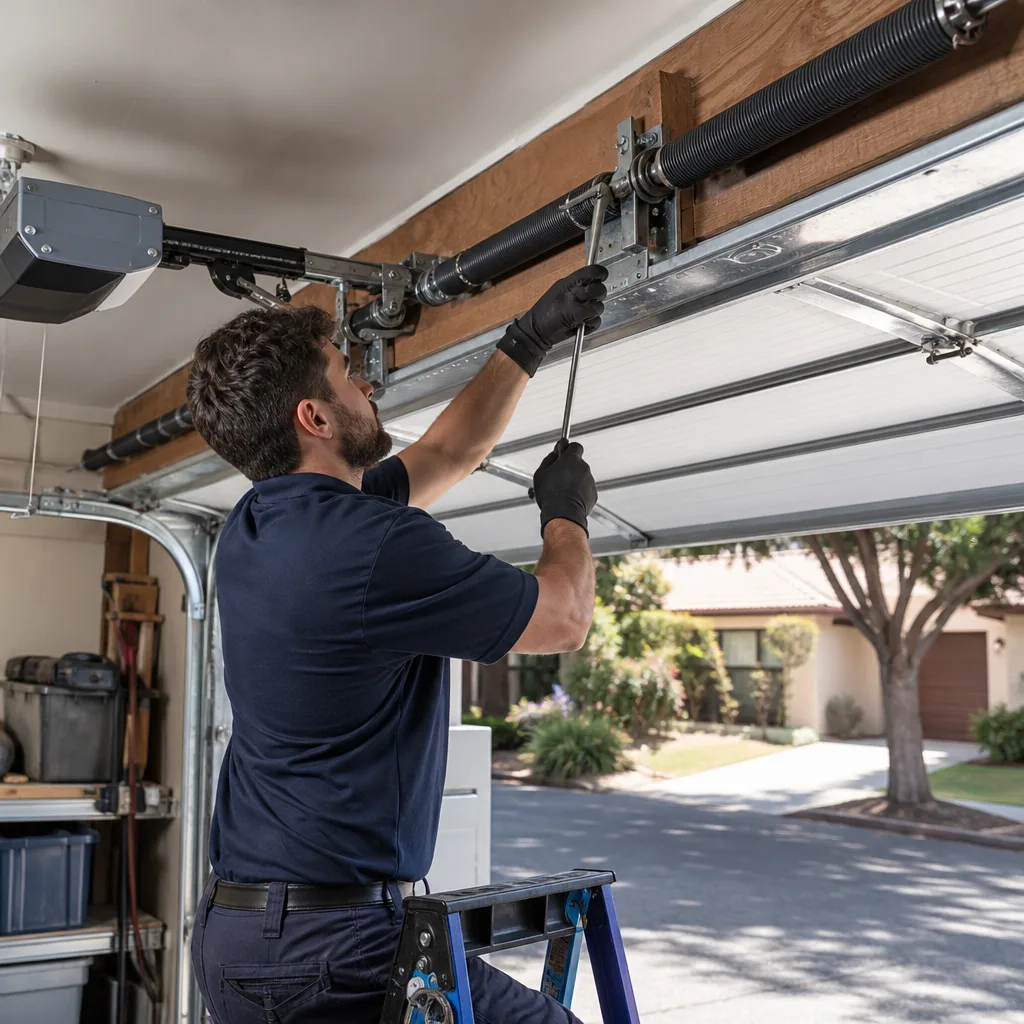 After
After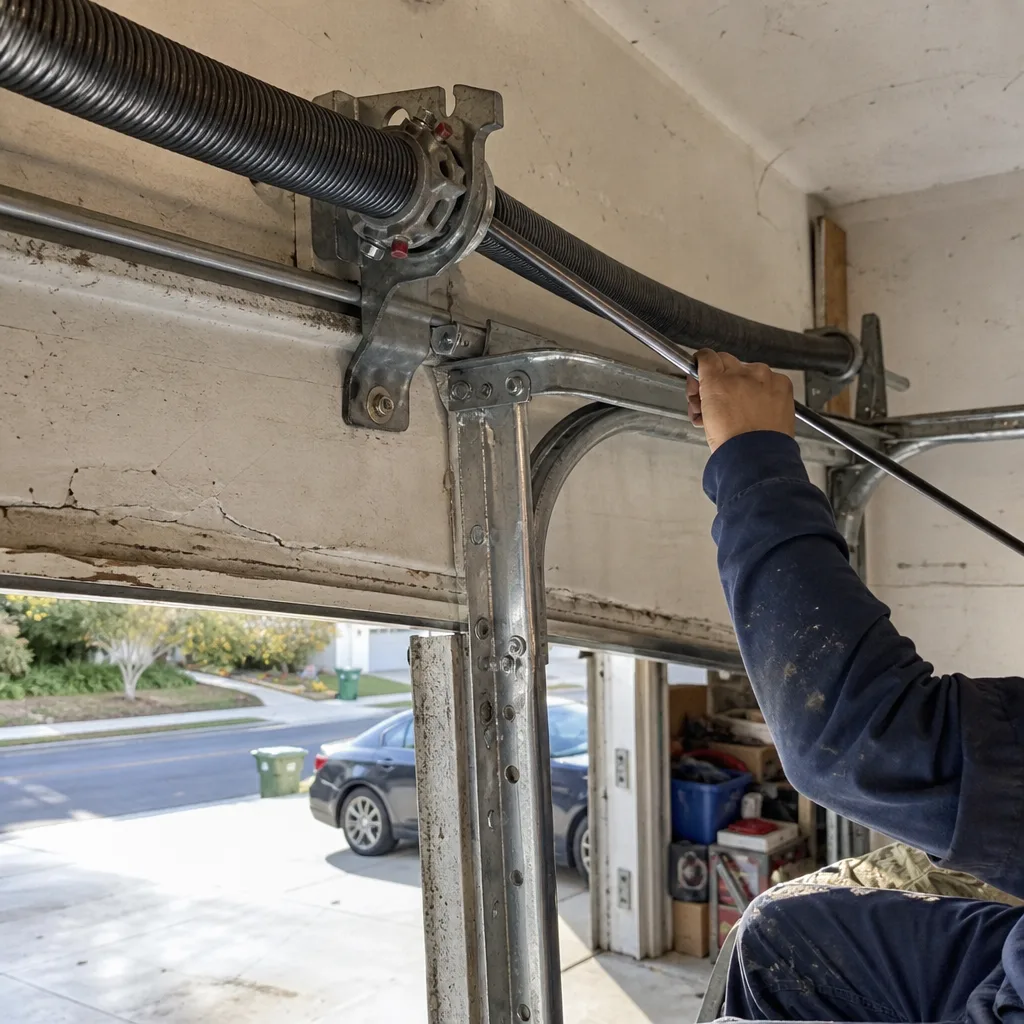 Before
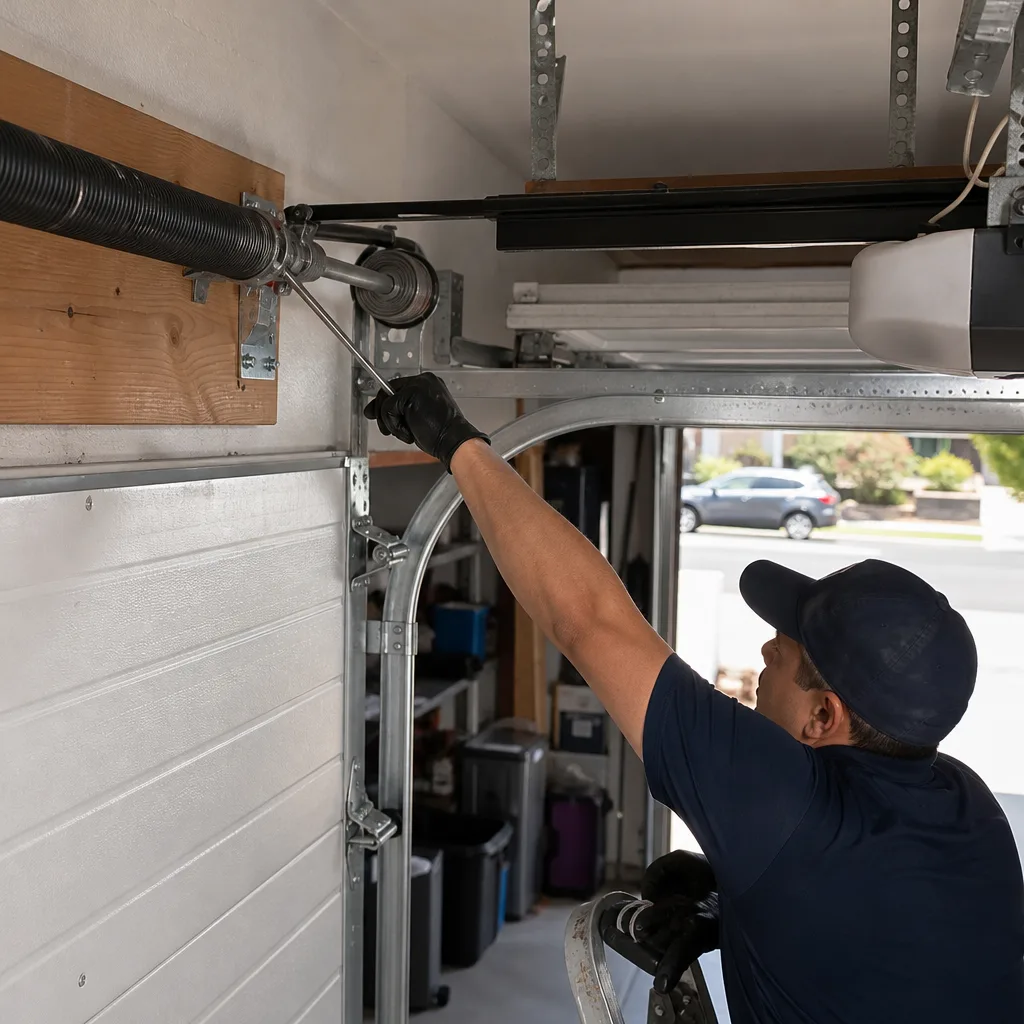 After
After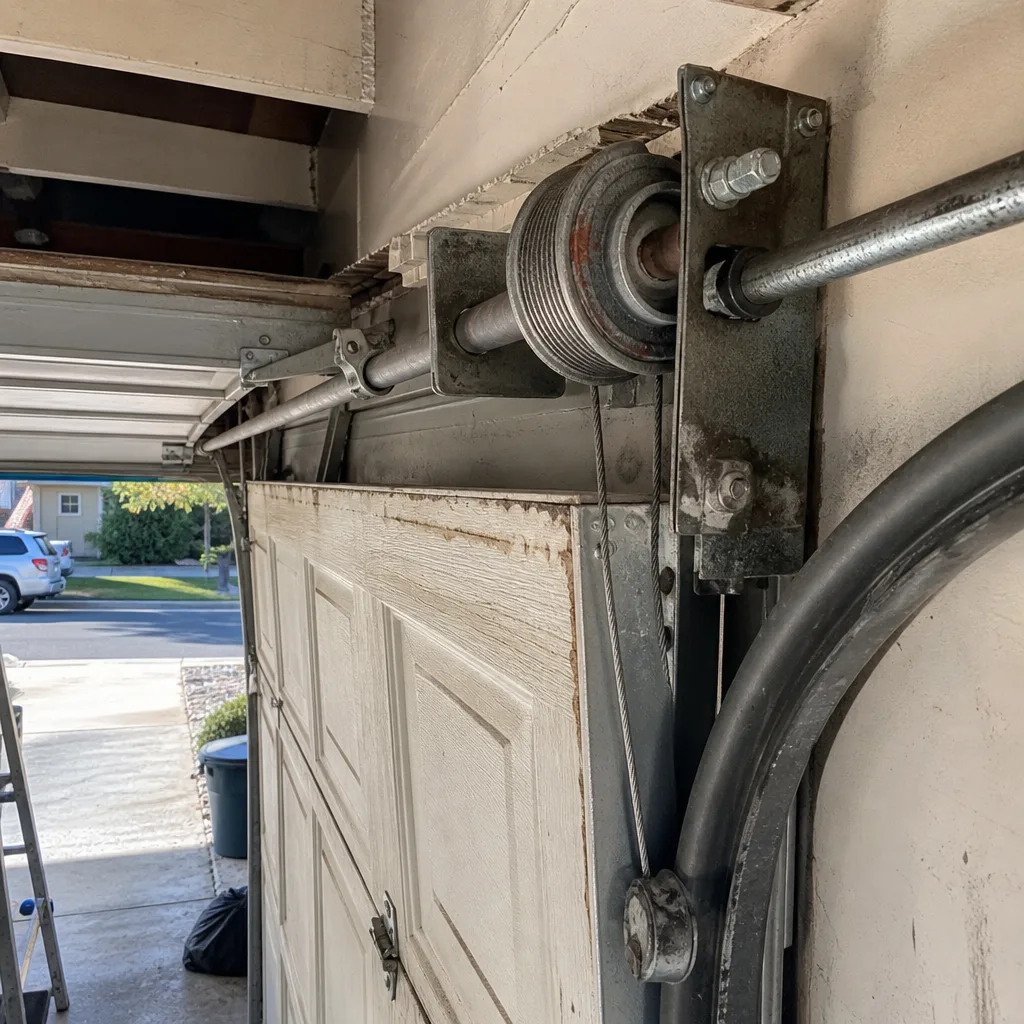 Before
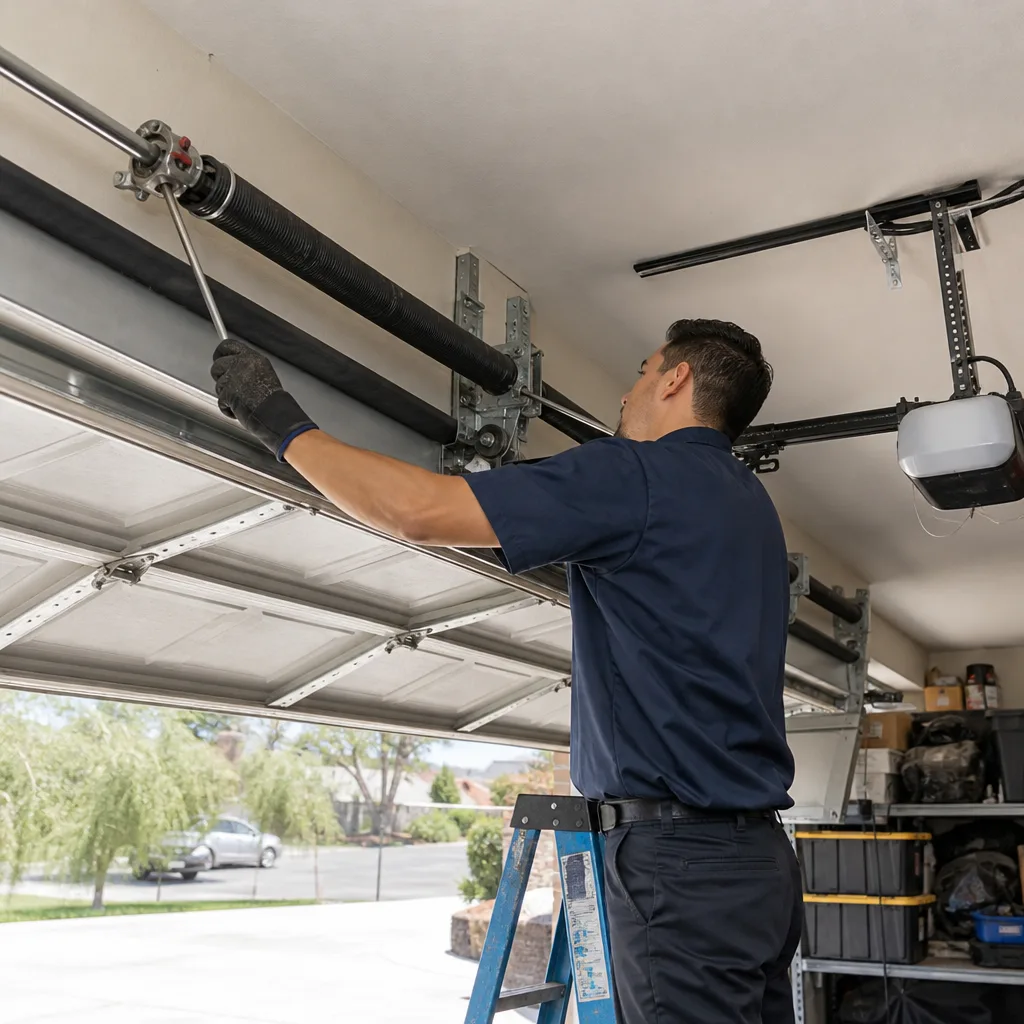 After
AfterHow to Hire a Garage Door Contractor in Los Angeles: A Step-by-Step Guide
In Los Angeles, a contractor performing garage door work valued over $500 must hold a C-61/D28 (Door and Gate) license from the California Contractors State License Board. The uncomfortable reality is that a meaningful share of garage door calls in LA are answered by unlicensed operators, moonlighters, or lead-gen marketing firms that resell your call to whoever bids lowest for the job lead. Most homeowners never check a license, never ask for a written price, and never realize they hired a dispatcher instead of a contractor. This guide gives you a concrete, repeatable screening process that cuts through the noise, with the exact verification steps we use when evaluating our own trade in Los Angeles. For more guides & resources on keeping your door reliable, see our blog.
Quick Answer
To hire a garage door contractor in Los Angeles, verify the C-61/D28 license on the CSLB website, confirm the company you called is the company that shows up, require a written price quote before any work starts, and ask directly about warranty terms. A legitimate contractor in LA will pass all four checks in under ten minutes total. Anyone who stalls on any of them is telling you something useful.
Table of Contents
- Step 1: Verify the C-61/D28 License in Under Two Minutes
- Step 2: Know Who Actually Answered Your Call
- Step 3: Demand a Written Quote, Not a Verbal Estimate
- Step 4: Read Reviews Like a Garage Door Professional
- Step 5: Ask Questions That Separate Prepared Contractors from Order-Takers
- Step 6: Get the Warranty in Writing
- Los Angeles-Specific Factors That Affect Your Decision
Step 1: Verify the C-61/D28 License in Under Two Minutes
California is one of the few states that makes contractor license verification genuinely fast. The CSLB website at cslb.ca.gov has a license check tool that returns results in seconds. Here is exactly what to do, and exactly what to look for.
- Ask the person on the phone for the company’s license number. A legitimate operation gives it without hesitation. If they demur, say they are “working on it,” or claim they do not need one for small jobs, hang up. The $500 threshold catches most spring, cable, and opener replacements in LA.
- Go to cslb.ca.gov, click “Check a License,” and enter the number. Confirm the business name on the license matches the name on the invoice you will receive.
- Check the classification. You want C-61/D28, which is the Door and Gate specialty classification. A general building license (B) is not the same thing and may not reflect door-specific training or insurance coverage.
- Check the status. It must say “Active.” Suspended, revoked, or expired means you have no CSLB recourse if the job goes sideways.
- Check the bond and workers’ compensation fields. A current bond is mandatory. Workers’ comp is required if the company has employees; a solo operator can claim exemption, but a company sending multiple technicians cannot.
In our experience across Los Angeles, a well-run operation hands over its license number the moment you ask. It is printed on the truck, the invoice, and the website footer. The operators who act insulted by the question are almost always the ones who do not have a number to give.
Step 2: Know Who Actually Answered Your Call
The single biggest structural problem in LA garage door hiring is the lead-gen intermediary. You search online, call a number that looks local, and reach a call center in another state. That call center sells your job lead to a contractor, often for a fixed fee per call. The contractor who wins the bid is not necessarily the one with the best reviews, the most experience, or any license at all. It is often whoever paid the most for the lead that hour.
How to tell the difference before you book:
- Ask “Are you the company that will send the technician?” A direct service company answers yes, immediately. A lead-gen aggregator will say something like “we partner with local providers” or “we’ll match you with a technician.” That language is a tell.
- Ask for the company’s street address in Los Angeles. A real contractor gives you an address. A lead broker gives you a PO box, a suite number in a shared office, or nothing at all.
- Ask whose name goes on the invoice. If they cannot tell you the legal company name before you book, you are not talking to the company that will do the work.
- Check the website’s service area page. A direct LA contractor will name specific neighborhoods like Sherman Oaks, Pasadena, Torrance, or Studio City. A lead-gen site will list dozens of cities across three states and read like a template.
- The exact scope of work. “Replace torsion spring” is acceptable. “Fix garage door” is not. The latter is a blank check.
- The brand and part numbers. If the quote says “spring, hardware” without specifying, you have no way to verify the part they install. A prepared contractor quotes parts the way a mechanic quotes a timing belt: by manufacturer and part number.
- The labor rate or flat labor charge. Flat is common in garage door repair. Either is fine, as long as it is explicit.
- The total price, including tax and any disposal or trip fees. If it is not itemized, it is not a quote.
- The warranty term. Written on the same document, not promised verbally. More on this in Step 6.
- The company name, license number, and technician signature. A quote without the license number is not worth the paper it is written on in Los Angeles.
- Generic five-star patterns. Real reviews from real driveway jobs describe something specific: a broken spring, a snapped cable, an opener that would not reverse. If a company’s reviews are all “great service, highly recommend” with no detail, those reviews were likely purchased or solicited in bulk. Real customers write about what was broken and what got fixed.
- Perfect scores with high volume. A company with 200 reviews and a flawless 5.0 average is statistically suspicious. Every legitimate contractor gets the occasional three-star review from someone who was unhappy about something minor. Flawless scores are a product of review filtering, not consistent performance.
- Reviewers with one post. Accounts that have reviewed exactly one business, ever, and gave it five stars, are a classic sign of coordinated review padding. Look at the reviewer’s history, not just the review.
- Reviews that name the technician. A genuine five-star review often names the person who did the work. A fake or generic review does not. The presence of named technicians in reviews is an authenticity signal that improves with company size and consistency.
- Negative reviews that are actually informative. You should read the one-star reviews before the five-stars. A legitimate company’s negative reviews cluster around scheduling delays or communication gaps, not around price changes at the door or work that failed within a week. The negative reviews tell you what it is like to have a problem with that company.
- The warranty term in days or years, explicitly stated. “One year” is meaningful. “We stand behind our work” is not.
- The warranty scope. Does it cover parts? Labor? Both? A spring that fails and is replaced under warranty but billed for two hours of labor is not a real warranty.
- The warranty trigger. What qualifies as a covered failure? Normal residential use should be covered. Damage from your own impact with the door is a different conversation, and a legitimate contractor will say so clearly.
- The remedy. What happens if it fails? A re-visit at no charge, a replacement, or a refund? A legitimate warranty describes the remedy, not just the promise.
- Who stands behind it. If the warranty comes from a lead-gen aggregator, there is no one to hold accountable. The warranty must come from the company whose technicians did the work, with a license number and a real Los Angeles address attached.
Brock Garage Door Repair is an independently owned and operated location within the Garrison Partners network. We answer our own calls in Los Angeles, and the technician who shows up at your door wears a uniform, has passed a background check, and works under the name you called. That transparency is the baseline every homeowner should expect, and it is surprisingly rare in this market.
Step 3: Demand a Written Quote, Not a Verbal Estimate
A verbal estimate over the phone means nothing in a dispute. It is your word against theirs, and in California, theirs usually wins because the invoice is the only document that matters. A legitimate written quote must include specific elements to be enforceable and useful. If the contractor refuses to put it in writing before starting work, that is a red flag the size of a garage door itself.
What a legitimate written quote includes:
Every job at Brock Garage Door Repair begins with a written price, handed to the homeowner before any work starts. The number on the invoice matches the number you approved. This is not a courtesy we extend when someone asks. It is the operating rule on every single job. If you are comparing contractors in Los Angeles, treat “written price first” as a non-negotiable filter. A company that will not commit a price to writing before work begins is a company that plans to move it later.
Step 4: Read Reviews Like a Garage Door Professional
Generic review advice tells you to check the star rating. The garage door trade has a specific review fraud problem that requires a more skeptical eye. Here is what we look for when we audit our own online presence, and what you should look for when evaluating any contractor in Los Angeles.
The goal here is not to find a contractor with no negative reviews. The goal is to find one whose negative reviews reveal ordinary operational friction, not systematic dishonesty. In Los Angeles, where the garage door repair market is saturated with marketing-first operations, this distinction is the difference between a company that fixes doors and a company that buys leads and churns through them.
Step 5: Ask Questions That Separate Prepared Contractors from Order-Takers
You can screen a contractor in ninety seconds of phone time by asking questions that require trade knowledge to answer well. Order-takers stumble. Prepared contractors answer without pausing. Here is the question set we recommend, with what a good answer sounds like.
Question 1: “What brands do your technicians work on?”
A prepared contractor names specific brands without hesitation: LiftMaster, Chamberlain, Genie, Raynor, and the rest. Our technicians service eight major brands, including LiftMaster, Chamberlain, Genie, Clopay, Amarr, Wayne Dalton, Craftsman, and Raynor. If you are weighing your options, our Choosing the Right Garage Door Brand: A Buyer’s Guide for Los Angeles breaks down what matters. An order-taker says “all brands” or “whatever you have.” That is not an answer, it is an evasion.
Question 2: “What is your arrival window, and what happens if you are late?”
A real operation gives you a window and holds itself to it. The Garrison Standard, the operating protocol Brock Garage Door Repair runs on, includes a defined arrival window on every scheduled call, not just a vague “sometime this afternoon.” If a company cannot tell you its arrival window policy in one sentence, you are talking to a dispatcher who will call you when they feel like it.
Question 3: “Is your price in writing before work starts?”
The only correct answer is yes. Not “we’ll give you a good deal,” not “we can work something out,” not “don’t worry about it.” Yes, in writing, itemized, before any work begins. This question alone eliminates a large share of the problem contractors in Los Angeles.
Question 4: “What is your warranty, and is it in writing?”
We will get into warranty structure in the next section, but the screening function is simple: if the warranty is verbal, there is no warranty. A 365-day written guarantee on repairs means the contractor is confident enough in the work to put their return trip obligation on paper. At Brock, that is the 365-Day Done Right Promise: if a covered repair fails within a year, we return and correct it at no charge, and that commitment is in writing on every job, not in a verbal assurance that evaporates after the truck leaves.
Question 5: “Can you give me your license number right now?”
A direct service company reads it off their license. An unlicensed operator changes the subject, explains that it does not matter for your job, or hangs up. In Los Angeles, this question is the fastest single filter in the hiring process.
Step 6: Get the Warranty in Writing
The garage door trade has a warranty honesty problem. A lot of companies will tell you on the phone that the repair is guaranteed, and then the guarantee vanishes the moment there is a dispute. The invoice says nothing, the contract says nothing, and the phone number stops being answered. In California, a verbal warranty is enforceable in theory, but in practice it is worth approximately zero without a document backing it.
Here is what to require:
Every repair at Brock Garage Door Repair is covered by the 365-Day Done Right Promise. If a covered repair fails within a full year, we come back and make it right at no charge. The promise is confirmed in writing, on the invoice, every single time. A free second visit if the repair fails is part of every job, not a negotiation point. In a Los Angeles market where verbal promises are the industry norm, a written guarantee is the fastest way to identify a contractor who plans to still exist next year.
Los Angeles-Specific Factors That Affect Your Decision
Garage doors in Los Angeles face conditions that homeowners in other markets do not think about, and a contractor who understands these factors is more likely to diagnose correctly the first time. Our Seasonal Garage Door Care for Los Angeles: Year-Round Homeowner’s Guide covers what to watch for each season. Here is what we see in our service area, from Santa Monica to Pasadena to the Valley.
The coastal marine layer is corrosive. Homes within a few miles of the ocean get salt-laden air that accelerates corrosion on springs, cables, and hardware. A torsion spring that lasts twelve years in Burbank might fail in eight in Venice. A contractor who understands this will inspect the spring and hardware for corrosion, not just for visible breaks. When we replace a cable on a coastal property, we are looking at the drum condition and the pulley wear that the salt air accelerates. For a deeper look at what goes into this work, see The Complete Garage Door Cable Repair Guide for Los Angeles Homeowners. If you are in a coastal neighborhood like Marina del Rey or Playa del Rey, ask your contractor directly whether they account for marine layer corrosion in their maintenance recommendations.
Older homes throughout Los Angeles, from Hancock Park to Highland Park, often have garage doors that are no longer standard sizes. A contractor who works on modern 7-foot doors all day may not have the knowledge to properly tension a spring system on an older, heavier, wood-paneled door from the 1950s or 1960s. Those doors are heavier, the spring systems are differently calibrated, and the fix requires knowledge that comes from working on the older housing stock, not just from a parts catalog. Ask whether the contractor has experience with pre-1970 construction. The answer matters more than most homeowners realize.
Los Angeles also has a high concentration of attached garages and garage conversions. In many neighborhoods, the garage has been partially converted, which changes how frequently the door operates and sometimes how it is balanced. A garage door that opens directly into living space gets opened and closed more frequently than a detached door used only for parking. If your contractor does not ask how often you use the door and what you use it for, they are not fully diagnosing the system. For opener issues specifically, see our Garage Door Opener Repair in Los Angeles page for a full breakdown of opener-specific diagnosis. For cable-related failures, which are common on older doors throughout the city, see Garage Door Cable Repair in Los Angeles.
Common Mistakes to Avoid
- Hiring from the first paid ad result without verification. Paid search ads in Los Angeles are dominated by lead-gen aggregators. The top result is not the top contractor; it is the top bidder for your click. Verify before you book, regardless of ad position.
- Accepting a phone estimate as binding. A price quoted over the phone before anyone has seen the door is a sales tool, not a quote. A real estimate follows inspection, and a real quote is written. Never let verbal numbers establish your expectations for the final invoice.
- Ignoring the license classification. A general contractor license does not indicate garage door expertise. Verify the C-61/D28 classification specifically. This is the single most common verification error we see in Los Angeles.
- Paying the full amount before the job is complete. A deposit is normal on large installations. Full payment before the door works, the site is clean, and the warranty document is in your hand is not. Legitimate contractors invoice after the work is done, not before.
- Skipping the written warranty because the phone rep was friendly. Friendliness is not a guarantee. If the warranty is not on the invoice, you do not have a warranty. This applies regardless of how reassuring the person on the phone sounded.
- Not asking who employs the technician. Many LA garage door jobs are subcontracted. The person you call may not be the person whose license covers the work. Ask directly: “Whose license number goes on my invoice?” If the answer is unclear, walk away.
When to Call a Professional
Garage door work involves high-tension components that injure people every year. The torsion spring, the thick coiled spring mounted above the door that bears most of the lifting load, is under enough tension to cause severe injury if it releases unexpectedly. Cables under that much tension can snap with enough force to cut. If your door has a broken spring, a snapped cable, a bent track, or an opener that has stopped reversing properly, stop using the door and call a contractor. These are not weekend projects, and no amount of online tutorial watching changes the physics. Brock Garage Door Repair offers free estimates in Los Angeles, and a live person answers calls 24/7 at (254) 602-5116. If your door is stuck open, stuck closed, or making sounds it never made before, call. The price is written before any work starts, so you will know exactly what it costs before anything gets done.
Frequently Asked Questions
A contractor performing garage door work over $500 in labor and materials must hold a C-61/D28 (Door and Gate) license from the California Contractors State License Board. Verify the number, status, and classification at cslb.ca.gov. For a broader look at how this applies to specific repair types, see Garage Door Repair in Los Angeles.
Most common repairs in Los Angeles fall between $150 and $400, depending on the part and the door. Cable repairs typically run $150 to $275. Opener repairs run $200 to $450 depending on the drive type and motor condition. Spring replacements run $250 to $375 for a pair, including labor, though older or larger doors push higher. The only way to get an exact number for your door is an on-site inspection with a written quote. Call (254) 602-5116 for a free estimate in Los Angeles.
Hiring a company that subcontracts means the person at your door works for someone else, and the warranty you receive is only as good as that sub’s willingness to fix problems. Direct service companies answer their own calls, send their own employees, and stand behind their own work. Ask before you book: “Whose license number goes on my invoice?” If the answer is not the company you called, look elsewhere.
A legitimate written quote includes the scope of work, brand and part numbers, total price including tax and fees, warranty term, company name and license number, and a technician signature. If any of those elements are missing, do not approve the work. Verbal estimates create disputes; written quotes prevent them.
You can ask for a breakdown of the quote, and a legitimate contractor will give it to you item by item. Negotiating below a written quote is rarely productive because the number reflects actual parts and labor, not padding. If a contractor immediately drops the price by 20% to close the deal, ask what they are removing from the job. Quality work at a fair price rarely has that much air in it.
A real warranty is a written document attached to the invoice that states the coverage period, what is covered, and what the remedy is. The 365-Day Done Right Promise at Brock Garage Door Repair puts exactly this in writing on every job: if a covered repair fails within a year, we return and correct it at no charge. There is no verbal promise that substitutes for a written one. If the warranty is not on paper, there is no warranty.
The Bottom Line
Hiring a garage door contractor in Los Angeles does not require trusting anyone. It requires a process: verify the C-61/D28 license, confirm you are talking to the company that will do the work, demand a written quote with part numbers and a total price, read reviews for specificity rather than star count, and get the warranty in writing. A contractor who passes those steps is operating like a professional. One who stumbles on any of them is telling you everything you need to know. If you are in Los Angeles and want to work with a company that runs on those rules, call Brock Garage Door Repair at (254) 602-5116. A live person answers 24/7, and the price is in writing before any work begins. Start at Brock Garage Door Repair home to see our full service area and warranty terms.
Written by Wade Mercer, Owner at Brock Garage Door Repair, serving Los Angeles since 2001.